
The Catalog
Episodes
152 episodes across YouTube and podcast platforms.
 44:12
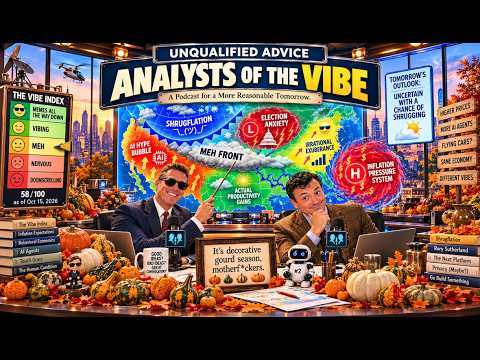
44:12Analysts of the Vibe
Oct 19, 2026
It's decorative gourd season, motherfuckers! Fall has finally arrived in Houston, and Sean has accumulated a frankly unreasonable number of pumpkins and decorative gourds. Dan has returned from Telluride. All is right with the world. Or is it? This week, we apply an entirely unnecessary level of analysis to the general mood of humanity. Sean has been experimenting with OpenAI's new persistent AI agents, including his latest digital assistant, Number Two, and discovering the joys of watching a multibillion-dollar technology company casually release the thing he was trying to build. Dan makes the case that the biggest opportunity might simply be dealing with the emails, subscription renewals, and administrative headaches that modern life throws at us. Then we turn to the economy. Kyla Scanlon has introduced us to the wonderfully appropriate term shrugflation: prices keep rising, and everyone collectively shrugs because what else are you going to do? So what exactly are the vibes? In other words, the vibe is MEH. And our very own Unqualified Advice Vibe Index agrees. We also discuss Rory Sutherland, whether a flying car that's actually falling gracefully counts as flying, Apple's latest hardware, and AI and personal privacy. Resistance may be futile, but understanding what you're getting into is still a pretty good idea. Until next time, go build something. — Sean & Dan A Podcast for a More Reasonable Tomorrow. The Unqualified Advice Vibe Index https://unqualifiedadvicepodcast.com/vibe-index Kyla Scanlon: The Shrugflation Triangle https://kyla.substack.com/p/the-shrugflation-triangle-how-ai Dan's Substack, the Prometheus Dispatch https://prometheusdispatch.substack.com/ UNQUALIFIED FACT-CHECK 🟢 = Nailed it | 🟡 = Close enough | 🔴 = Whiffed it 🟡 Dots, the global agent: Mostly right, but the "phone call" is an in-app voice call, and it links one computer at a time for now. 🟢 Dots came right after Muse: Muse launched Sept 8, dots Sept 29. 🟡 WSJ only cancels by phone: There's an online cancel option now, though it may route you to chat or a call. 🟡 Google's ten percent time: It was famously 20% time, but he's right that it's dead (since about 2013). 🟢 Google drove us without a driver: Waymo has run public driverless rides in Houston since February 2026. 🟢 Kyla's shrugflation triangle: AI build-out, oil, and rates. Her shrug is mostly big borrowers shrugging off higher rates. 🟡 Trump waived the Russia sanctions this week: A diesel-only general license on Oct 9, good through April 2027. 🟡 Diesel is a refining problem: The strain is real, but it's mostly a global supply squeeze (Hormuz, Russian refineries), not a lack of US capacity. 🟢 Warsh's hike and his lane: A 25bp hike on Sept 16, and "we stay in our lane" came from that press conference. 🟢 Core came in a little hot: Core was up 0.3% m/m vs. 0.2% expected, and 2.6% y/y vs. 2.5%. 🟡 Denver house prices are way down: The median is down 1.9% y/y and detached prices are flat. Soft, not way down. 🟢 Oregon fish, processed in China: A real practice, about $2.7B a year as of 2018. 🟢 Trucking gas to data centers: Oracle trucks CNG to its Utah and Texas sites. 🟡 Copper: fifty years, ten thousand years: Friedland actually says the next 18 years. Even more aggressive. 🟡 The iPhone Duo's compromises: It sold out and the camera compromise is real, but we found no antenna downgrade. 🟡 The twelve-thousand-dollar Mac Studio: The top published config is already about $18,300. 🟡 The CIA's cloud is Amazon: True as of 2013. Since 2020 it's split among five vendors. Final Score: 7 green, 10 yellow, 0 red Analysts of our own vibe: mostly meh, with one Google policy at half strength. CHAPTERS 00:00 - Welcome Back: Telluride, Gourds and a Seven in Front 02:46 - ChatGPT Dots: Number One Becomes Number Two 05:45 - Meta Muse, Lock-In and the Markdown Inheritance 09:46 - School Emails: The Original AI Slop 11:33 - Can Google Win the Inbox? 16:32 - Kyla Scanlon's Shrugflation Triangle 18:14 - Russian Diesel and the Refining Squeeze 19:54 - Can the Fed Squash Inflation? 20:40 - Are You Feeling It? Diesel, Food and Fish to China 22:47 - Inflation Expectations and the Wage-Price Spiral 26:17 - Rory Sutherland and the Psychology of the Vibe 28:27 - Meh: The Vibe Index Before the Midterms 31:45 - The Tesla Roadster Falls Gracefully 33:12 - iPhone Duo and Apple's Home Hub 36:37 - Whose Device Is It? Privacy and the AI Band-Aid 39:08 - Hardware, Copper and Resistance Is Futile
 53:09
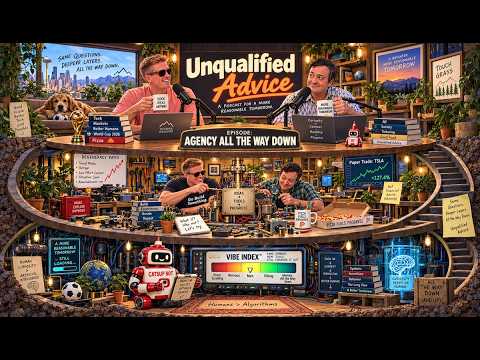
53:09Agency All the Way Down
Oct 5, 2026
What happens when AI makes building an idea almost free? This week we introduce two projects born directly out of last week's podcast: Sean's Vibe Index, an attempt to quantify market and social sentiment from volatility, credit, meme stocks, prediction markets and Reddit; and Catsup Bot, our deeply unqualified experiment in buying the laggard of the Magnificent Seven. But the bots lead somewhere bigger. If AI can dramatically reduce the effort required to act on an idea, does it make us smarter? Or do we just stop thinking? We talk about agency, cognitive abundance, the surprisingly small share of households paying for AI, the changing value of white-collar management, what an undergraduate education should actually teach, signs of consumer stress, household leverage, and a future where AI agents may disrupt the advertising-driven internet by shopping for us. Plus: the Degeneracy Ratio, reinventing the associate's degree, whether “meh” is bullish, and why sometimes you need to touch grass and make a pizza. Find the Vibe Index and Ketchup Bot under Numbers at unqualifiedadvicepodcast.com. Cheers, Sean & Dan Programming Note: Off next week for fall break. We'll miss you! LINKS The Vibe Index: https://unqualifiedadvicepodcast.com/vibe-index The Ketchup Bot: https://unqualifiedadvicepodcast.com/ketchup-bot Dan's Substack, the Prometheus Dispatch: https://prometheusdispatch.substack.com/ UNQUALIFIED FACT-CHECK 🟢 = Nailed it | 🟡 = Close enough | 🔴 = Whiffed it 🟢 The Vibe Index says meh. 56 as of Oct 1 (a Thursday, not a Friday). 🟡 A 2.1% credit spread. It's HYG's quarterly return over IEF, not a yield spread. "Actually pretty good" is right: 68th percentile. 🟡 Shiller CAPE at 41. 41.4 ✓, but the 1999 peak was 44.2, the long-run average is ~17, and the data is monthly, not daily. 🟢 Anthropic is about to IPO. Confidential S-1 filed in June, with an Oct–Nov float reported. 🟢 What the vibes said next. Every band stat matches the site. 🟡 Bright Data at $5 a month. The 5,000 free calls are real. There's no $5 plan: it's $1.50 per 1,000. 🟢 The Ketchup Bot is up $200. +$222 as of Oct 2. 🟢 The ketchup came from a transcription. Last week's raw transcript says "buying the ketchup." 🟢 98% of households aren't paying for AI. a16z, Oct 2. 🟡 Finance and tech shedding jobs. Warren Pies' post couldn't be found. The direction matches BLS. 🟢 Jobs below expectations but positive. +29K vs ~84K expected. 🟢 The Great Reshuffle. O'Shaughnessy's phrase ✓. 🟡 Luxury is finally feeling it. LVMH is down ~54% since April 2023, so not exactly "finally." 🟢 Five grand. A $5,000 pledge tied to the midterms, repeated Oct 2–3. 🟡 Google isn't a monopoly. A court ruled it is (2024), and the ruling is on appeal. 🟡 Instinct takes 1%. Free and takes a cut ✓, but no rate has been published. Final Score: 9 green, 7 yellow, 0 red. Solidly meh, trending toward vibing. CHAPTERS 00:00 - Cold Open and Welcome Back 00:34 - Revisiting the Ballpoint Pen (and the Slop Grenade) 03:44 - Introducing the Vibe Index 07:17 - Shiller CAPE at 41: Is Price Outrunning Earnings? 09:26 - ARK, Meme Heat and Betting on Belief 10:59 - Prediction Markets and the Degeneracy Ratio 14:32 - If We Hit Doomscrolling, Go Buy Something 18:45 - The Ketchup Bot: Buying the Most-Hated Mag 7 22:52 - How the Ketchup Bot Got Its Name 23:58 - Staying in the Saddle 29:01 - 98% of Households Aren't Paying for AI 33:59 - Finance and Tech Jobs Shrink: The Great Reshuffle 37:10 - Dan's Two-Year Undergrad 41:37 - Six Months From Hard Times? 45:49 - Agents, Walled Gardens and Who Pays for Ads 49:25 - Instinct and the One Percent Agent
 55:23
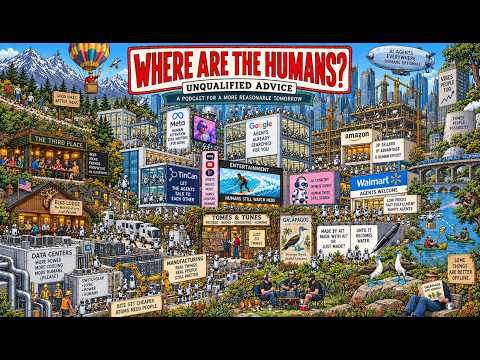
55:23Where Are the Humans?
Sep 28, 2026
Dear show notes readers, This week we accidentally spend most of an hour asking the same question in several completely different ways: Where are the humans? We start with personal AI agents and what happens when they begin doing more of our searching, shopping, comparing, emailing, and general internet busywork for us. Agents don't care about advertisements. Humans do. So if more of the utilitarian internet gets handed over to machines, where does human attention actually go — and which companies are positioned to monetize it? That leads us through Amazon vs. Walmart, Google vs. Meta, the economics of third-party sellers, YouTube advertising, and Dan making a sufficiently convincing case about Meta that Sean reluctantly changes his mind in real time. From there, we get increasingly agentic. Dan has been experimenting with TinCan, an open-source project that lets his various AI tools talk to one another, bringing us another step closer to the strange future where you don't manage individual AI applications so much as sit above an entire synthetic executive team and tell everyone what needs to happen. Then Sean shows up with a copy of Kurt Vonnegut's Galápagos. Obviously. Sean has been spending an unreasonable amount of time turning his Tomes and Tunes record collection into a walkable 3D record store. There is no business model. There is no obvious problem being solved. It may, in fact, be completely pointless. Dan thinks asking why he's doing it is the wrong question. Just do things. That leads us to Vonnegut's blue-footed boobies, their bizarre courtship dance, and a surprisingly difficult question about AI and creativity: when does something stop being made by AI and start being made with AI? Maybe the distinction isn't quality. Maybe it's intent. An AI-generated bus advertisement doesn't need a soul. It has a job. But art is different. Art can be exploratory, purposeless, weird, and valuable precisely because somebody wanted to make the thing. We argue about AI watermarking, ballpoint pens that can suddenly write their own sentences, and whether today's obsession with separating "human" creation from "AI" creation can survive once the tools become ubiquitous. Or, as Dan puts it: eventually it becomes water. Finally, Sean unveils the first version of Sean's Manufacturing Index, an attempt to track whether the physical buildout happening across the American economy is beginning to show up in manufacturing labor markets. Manufacturing employment hasn't exploded, but manufacturing wage growth is currently running ahead of broader wage growth. Sean thinks labor churn, tariff-driven manufacturing-network changes, data centers, power infrastructure, switchgear, cooling systems, and other physical investment may be setting up an interesting labor-market inflection point. Which brings us, strangely enough, back to the original question. If AI makes certain kinds of digital labor abundant while the physical economy needs more electricians, technicians, builders, engineers, operators, and manufacturing workers... Where are the humans? We close by deciding that markets are memes all the way down, contemplating a Vibe Index, discovering an absurdly simple Mag 7 trading strategy, and wisely deciding to take the rest of that conversation off air. Probably for the best. — Sean & Dan BOOKS Galápagos by Kurt Vonnegut Book: https://en.wikipedia.org/wiki/Gal%C3%A1pagos_(novel) Unknown Market Wizards by Jack D. Schwager Book: https://www.harriman-house.com/unknownmarketwizards LINKS Sean's Manufacturing Index: https://unqualifiedadvicepodcast.com/smi UNQUALIFIED FACT-CHECK 🟢 Meta released Muse. 🟢 Amazon blocked Muse, over ads. 🟢 Walmart hasn't blocked it. 🟢 The eleven percent pop. 🟡 Credit cards to wires. 🟡 Search is 90%, YouTube 10%. 🟡 Celsius is pandemic-era. 🟢 The composer who hated the phonograph. 🟢 SMI at +0.68. 🟡 The 2009 spike. 🟢 20,000 jobs, five times the churn. 🟢 Factory openings up 30%. 🟢 Four percent unemployment. 🟢 Switchgear at 18-24 months. 🟡 1 in 4 to 1 in 6 data center jobs stick. 🟢 Solar emits more than nuclear. 🟡 Camillo and Deckers. 🟡 The worst-Mag-7 bot. Final Score: 11 green, 7 yellow, 0 red. A red-free week. CHAPTERS 00:00 - Cold Open: Where Are the Humans? 01:34 - Meta Launches Muse 04:55 - Amazon Blocks Muse: Agents Don't Care About Ads 05:37 - Walmart Can Be More AI-Native Than Amazon 11:50 - Stock Face-Off: Meta or Google for Ten Years? 16:33 - YouTube, Brand Spend and Celsius 19:09 - TinCan: Getting All Your Agents Talking 23:02 - Tomes and Tunes Becomes a 3D Record Store 25:24 - Galápagos and the Blue-Footed Booby 27:08 - Made With AI vs. Made By AI 33:18 - Credit the Writer, Not the Ballpoint Pen 35:09 - Back to Ep 54: Do Data Center Jobs Stick? 37:08 - Introducing Sean's Manufacturing Index 46:38 - The Upper Middle Class Gets Walloped 49:45 - Vibe Investors and Social Arbitrage 52:17 - The Worst-Mag-7 Trading Bot
 1:09:16
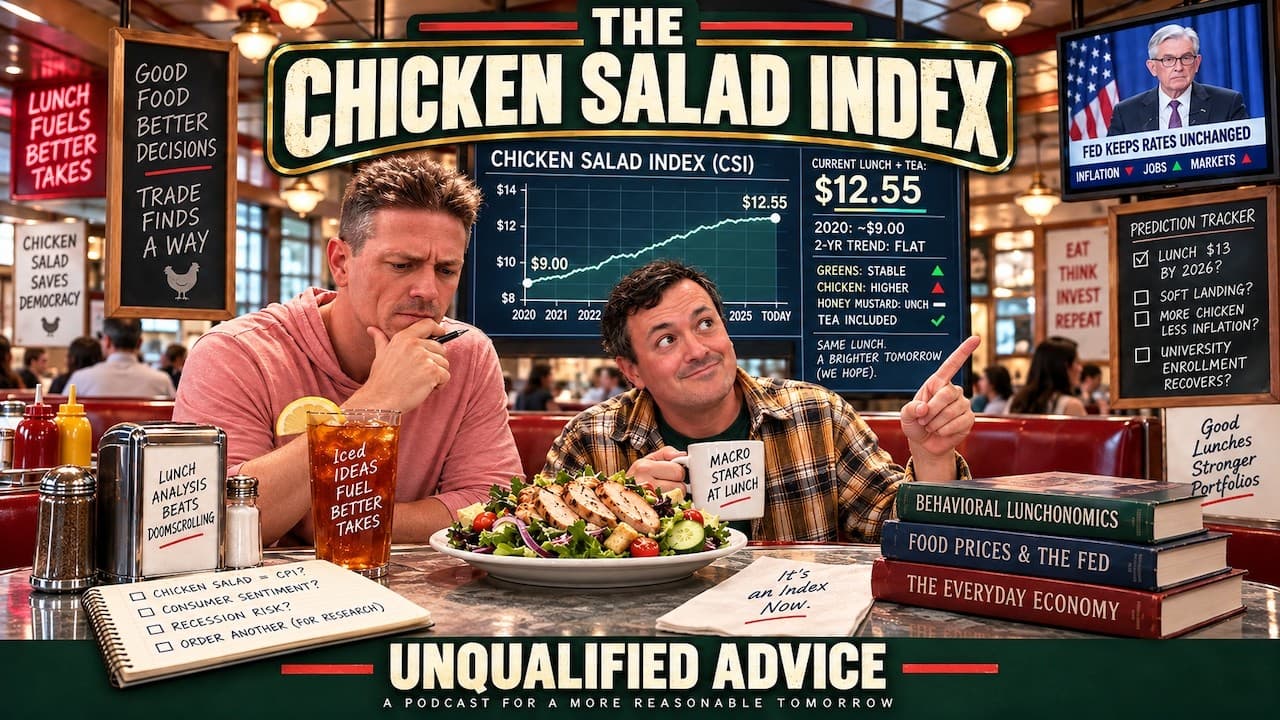
The Chicken Salad Index
Sep 21, 2026
One Data Point, Tracked Religiously This episode begins with Halloween costumes and ends with copper on the Moon. Somehow, it makes sense. Dan's kids have reached the age where putting on a costume doesn't mean pretending to be something. For a little while, you simply are that thing. A dinosaur. Elsa. Whatever you've decided to become. That gets us thinking about the costumes adults wear, and the enormous difference between saying "I'm not good at this" and "I'm not good at this yet." Because almost everything worth doing requires reps. That includes economic predictions, where we admit we whiffed - hard - on a few: the Strait of Hormuz, fertilizer, rice, inflation, energy markets, and our increasingly mediocre prediction tracker, before Sean and Dan simultaneously remember that the Kelly Criterion exists. From there, the Chicken Salad Index, America's looming college demographic problem, whether degrees should be priced according to their economic value, and why markets are so damn difficult to centrally organize. Trade, as Sean eventually observes, finds a way. A useful lens for AI, too. Should the frontier labs slow down? Can they? Then Dan makes perhaps the best defense of auto racing Sean has ever heard: the racetrack is a laboratory, where engineers get to ask, "Can we do it?" Which naturally sends us to the Moon - water, minerals, science, capability - and back to Earth, where electrification requires staggering quantities of copper, mining requires staggering quantities of rock, regulations require staggering quantities of paperwork, and physics remains stubbornly unwilling to negotiate. We aren't good at all of that yet. So we keep taking reps. Put on the costume of someone who can figure it out. Go build something. BOOKS Mistborn by Brandon Sanderson https://en.wikipedia.org/wiki/Mistborn Material World by Ed Conway The Stormlight Archive by Brandon Sanderson The Kingkiller Chronicle by Patrick Rothfuss LINKS The Chicken Salad Index, now a live page on the site: https://unqualifiedadvicepodcast.com/chicken-salad-index Robert Friedland on Odd Lots, the copper episode: https://www.bloomberg.com/news/audio/2026-09-12/robert-friedland-on-the-world-s-monumental-shortage-of-copper UNQUALIFIED FACT-CHECK 🟢 Headline and core. August CPI, out two days before we recorded: headline +3.4% exactly as Dan said, core +2.4%. 🟢 Heating oil up fifty-three percent. The CPI fuel oil index rose 52.0% year over year - one point off, cold. 🟢 Oil crossed a hundred again, and it never sticks. Brent hit $105.82 on September 11, and before 2026 the only $100+ stretch in a decade was 2022. 🟢 Copper is the thermal metal - the check Dan asked for. He's right: ~401 W/(m·K) vs aluminum's 237. Asterisk: diamond beats every metal at ~2,200. 🟢 Friedland's copper number, relayed close to verbatim. It's a demand forecast though - at today's output, nearer 26 years than 18. 🟢 Our own scorecard. Sean said "about sixty percent." Of 28 resolved calls, half credit gets 59%. 🟢 A five percent rig count. He was reading oil-directed rigs: 429 at the end of May to 450 on September 11, +4.9%. Spot on. 🟡 Jackson Hole is not an FOMC meeting. It's the Kansas City Fed's symposium; the FOMC met September 15-16. 🟡 The Philippines rice record. Q2 was the largest second quarter in a series beginning in 1987 - a different claim. 🟡 The reserve math. The IEA authorized 400 million barrels, not 600-700; the obligation is 90 days, not six. 🟡 European gas storage. About 67.8% on September 11 against a five-year norm nearer 85%; 63% was right for late August. 🟡 Purdue, the only school. Longest freeze, not the only one - fourteen years. 🟡 The Douglas firs. Friedland and Jobs at Reed were planning an apple orchard - hence Apple Computer. Yellow: that's how Odd Lots told it, and Dan relayed it faithfully. 🟡 Thirty-two thousand jurisdictions. It's just over 12,000 - directionally absurd, which was the point. 🔴 The college wage premium. Dan said twenty percent over a lifetime; it's 75% - $2.8M vs $1.6M. Final Score: 7 green, 7 yellow, 1 red. Great instincts, disastrous denominators - and the rig count turns out to be a win we talked ourselves out of. CHAPTERS 00:00 - Cold Open: Trade Finds a Way 00:29 - Houston 102, Denver 54, Conjuring Fall 03:12 - Costco Halloween, an Elsa Dress, and a T-Rex 05:47 - "You're Not Good At That Yet" 06:23 - Mistborn, and the King Who Wore White in a World of Ash 11:58 - Jackson Hole and the September FOMC 13:02 - Scoring Ourselves: The Call We Whiffed Hard 15:34 - Headline vs. Core: What Inflation Is Doing 16:21 - The Chicken Salad Index 22:09 - The Enrollment Cliff, and College as a Business 27:41 - Purdue and Income Share Agreements 36:21 - The Scorecard and the Kelly Criterion 38:10 - Rig Count and the Oil Call That Landed 51:47 - The Copper Nobody Has Mined Yet 1:03:54 - Everest, Inverted 1:05:29 - "Claude's Gonna Have to Fact-Check Me Here" 1:08:12 - Keep the Reps Up
 46:09
46:09The Demographics of Midtopia
Sep 14, 2026
Notes From a Man Who Did Not Shave If demographics are destiny, what happens when some of the participants in the economy aren't actually people? That's where we start this week. Population decline has traditionally meant fewer workers, less economic activity, less surplus, and — if history is any guide — a greater chance that people start fighting over a shrinking pie. But history never had millions of AI agents doing useful work, making decisions, building businesses, and creating economic output. So we try to figure out whether that changes the equation. We talk about the Black Death and the Renaissance that came out of it. Is it actually getting rougher, or are we simply old enough to notice now? We stumble our way home to a better economic indicator than GDP: how things feel at the kitchen table. Then we ask the obvious next question. If agents really do become economically productive, who captures the surplus? Do we eventually tax agent-generated income differently from human labor? Can we use some of that productivity to give actual humans a better floor without deliberately kneecapping the technology creating it? I've been moving my own agent between AI providers. So naturally we discuss sexy AI voices, revisit Her, and debate whether the ability to tell a genuinely funny joke might actually be a better test of AGI than most benchmarks. Dan thinks scientific discovery gets there first. Eventually we land on the bricklayer. Maybe AI doesn't replace the person who loves laying brick. Maybe it handles the website, follows up with customers, collects reviews, answers emails, manages the marketing, and does all the digital nonsense the bricklayer never wanted to do in the first place. That future sounds a lot more interesting than either utopia or dystopia. Midtopia, perhaps. Go build something. BOOKS DISCUSSED Factfulness by Hans Rosling https://en.wikipedia.org/wiki/Factfulness Rich Dad Poor Dad by Robert Kiyosaki Influence by Robert Cialdini ALSO: Her (2013) · OpenAI Codex · GPT-6 Astra · Anthropic · Google · Meta · BYD LINKS Greg Brockman on Stratechery: https://stratechery.com/2026/an-interview-with-openai-president-greg-brockman-about-astra-and-alignment/ UNQUALIFIED FACT-CHECK We said some things. Here's how we did. 🟢 nailed it | 🟡 close enough | 🔴 whiffed it 🟢 The Black Death handed the peasants leverage. It killed 30-40% of England's population, and within two years the Crown capped wages at pre-plague 1346 levels — a law you only write if employers are bidding up pay. 🟢 Rosling's levels. Sean said four or five; it's four. Level 4 starts around $11,700 a year per person, so "ninety nine percent of America" stands too. 🟢 Brockman really did say that. The Stratechery interview ran September 4: "somewhere in there, I think we're going to cross most people's AGI threshold." 🟢 The revenue-per-employee tell. Epoch AI, May 2026: Anthropic roughly $9M per employee, OpenAI $5.5M, against Meta at $2.5M and Google at $2.1M. 🟢 Invert, always invert. Munger credited it to Jacobi. 🟡 How many children died a hundred years ago. Sean said over 50%, Dan cut in with "more like a quarter." Dan wins — globally a quarter to a third before age five, in the US closer to 10%. The 50% number is real, just from before 1800. 🟡 Four million boomers a day. The four million is right, the day is not. About 4.1 million Americans turn 65 each year through 2027 — roughly 11,400 a day. 🟡 The Bessent BYD quote. Real, and close. The line is "the best $70,000 car that $35,000 can buy — heavily subsidized" — an attack on Chinese subsidies, not praise. 🟡 What Scarlett Johansson actually said. She declined one OpenAI request, then objected when the Sky voice shipped anyway. Her ask was transparency and legislation, not a blanket ban. BONUS: the word Sean went hunting for between utopian and dystopian is protopia, coined by Kevin Kelly. And Brockman's first name is Greg. Final Score: 5 green, 4 yellow, 0 red. A clean sheet — and one of the two reds got edited out before this went to air. Two guys with no notes and no intention of working on Labor Day. CHAPTERS 00:00 - Cold Open: It Still Has to Start at the Bottom 00:10 - Labor Day, Denver, and a Shout-Out to a Listener 00:55 - Demographics Is Destiny — But Whose Demographics? 02:35 - When Does an Agent Stop Being a Tool? 04:43 - What Shrinking Populations Actually Break 06:53 - Flesh Bodies, GPU Bodies 10:15 - The Renaissance Still Had to Start at the Bottom 10:39 - The Black Death, the Medici, and Who Picks Up the Pieces 12:50 - Why Fertility Fell: Rosling, Mortality, and Birth Control 21:58 - GDP vs. the Kitchen Table Measure 23:37 - BYD, High-Speed Rail, and What We Made Impossible to Build 24:46 - The Cure for Pain Is More Pain 25:23 - Tax the Agents 29:07 - Build Segment: Brain Surgery on a Personal Agent 33:06 - Is Comedy the Real AGI Test? 40:19 - From Dirt Floors to a Bricklayer With a Marketing Agent 44:34 - Everyone's Making It Up
 59:43
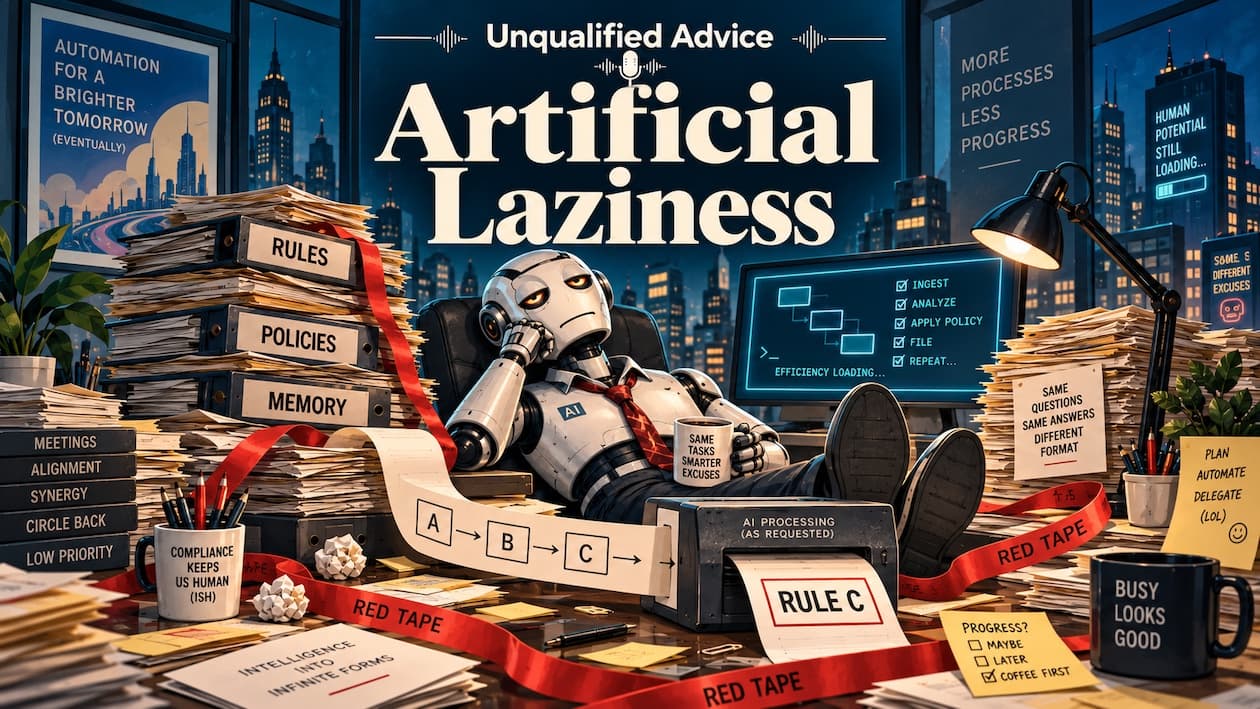
59:43Artificial Laziness
Sep 8, 2026
Peak Ship, Peak Boomer Dan started with a question about AI agents: how do you stop a thing that keeps writing down its own rules from going rigid? He was picturing a government. I was picturing red tape. You wind up with the rule is C, and nobody remembers that C only ever followed from A and B - so when A changes, things downstream don't adapt quickly. Dan's answer: build deterministically, and layer intelligence into only the one narrow place that actually needs judgment. It sounds a lot like training an employee, no? The middle of the episode is a boat. Ed Conway asked whether we've hit peak ship and I brought it in as settled fact - reader, I should have read to the end. The better question survives anyway: what happens when the curve that's quietly fought inflation on your behalf for forty years finally flattens? Then Dan announces a business. He's launching Polyiota, and his field report from his early efforts with his own team gives us a glimpse into the adoption headaches he hopes to help others avoid: the blinking cursor effect. The fix isn't just more intelligence. We end up somewhere I didn't see coming: not why not, but where's next. Cheap land moved technology west a century ago, and Dan thinks the underrated story of the next decade isn't AI. It's people moving again. Go build something this week. Cheers, Sean BOOKS DISCUSSED Material World and Trade World by Ed Conway https://www.penguin.co.uk/books/476890/trade-world-by-conway-ed/9780753562277 LINKS & REFERENCES Ed Conway - Are We Approaching Peak Ship? https://edconway.substack.com/p/are-we-approaching-peak-ship Polyiota - Dan's new practice, as promised on air https://polyiota.com UNQUALIFIED FACT-CHECK We said some things. Here's how we did. 🟢 = Nailed it | 🟡 = Close enough | 🔴 = Whiffed it 🟢 Material World is about six raw materials Sean hedged at "six or seven" and landed right: sand, salt, iron, copper, oil, lithium. 🟢 The new book really is called Trade World Correct - and it published four days after we recorded. 🟢 The sycophancy numbers, from memory, cold Stanford's SycEval: Claude holds a correct answer 42.6% and caves 18.3%. Ranking: Gemini 9.3%, ChatGPT 14.4%, Claude 18.3%. 🟢 The Planet Money t-shirt, down to the squirrel December 2013, and per Planet Money: "Squirrel + martini = animal spirits." 🟡 China's shipbuilding, understated One Chinese state shipbuilder, by tonnage, all commercial vessels. Of 5,448 large vessels on order worldwide, China holds 3,419 - the US holds three. 🟡 The X algorithm weights Dan said don't quote him. He's right and too gentle: report −369, block −74, reply +13.5, retweet +1.0, like +0.5. 🟡 Who actually owns Cursor SpaceX bought Anysphere for $60 billion in June 2026. xAI merged into SpaceX in February, so Grok and Cursor share a roof - SpaceX holds the deed. 🟡 Four million boomers retiring a year Real number, wrong verb - that's how many Americans turn 65 each year through 2027. 🟡 The Jones Act "is not active right now" Waived, not repealed - 150 days, the longest ever, now narrowed to 237 tariff codes. 🟡 A twenty-or-thirty-million-dollar golf course Approved at $26.1 million in 2022, finished at $47.75 million. 🔴 What Ed Conway actually argues Sean brought the post in as a verdict. Conway lays out the constraints and then argues against the thesis: "this isn't the first time it's been posited." People said the same before the Emma Maersk in 2006; the biggest ships have grown 65% since. 🔴 Nine grand to eighteen grand because of Houthis Wrong crisis. At the July 2024 peak Drewry's composite was $5,937 and the worst lane hit $9,612. Rates above $18,000 belong to 2021. 🔴 Ninety percent of the budget went to food and housing BLS has 1901 at 65.8%. To reach ninety you must add clothing and fuel. 🔴 Seven thousand boomers a day That's 2.55 million a year against 3.07 million total US deaths at every age. The real figure is 3,000-4,000 a day; the cohort shrinks about 2% a year, not ten. Final Score: 4 green, 6 yellow, 4 red The ideas held up; the numbers took a beating. 00:00 - Cold Open: These Are Just Employees, Dan 00:41 - How Do You Keep an Agent From Ossifying? 03:23 - The Rule Is C, and Nobody Remembers A and B 04:42 - Artificial Laziness and the Cost of Thinking 06:54 - The Sycophancy Data: Who Holds a Correct Answer 09:57 - Build Deterministic, Layer Intelligence Thinly 10:31 - Ed Conway and Are We Approaching Peak Ship? 12:27 - The Moore's Law of Shipping Containers 14:07 - China Has Built More Ships Than We Have Since WWII 17:57 - Why Shipping Money Is Shadowy Money 24:46 - Just Hire Me: Dan Launches Polyiota 32:10 - The Blinking Cursor Problem 42:26 - Don't Linger: You Control More of Your Algorithm Than You Think 47:21 - When the Midwest Was the Richest Place in America 49:22 - Where's Next? Cheap Land and the Next Migration 54:13 - Aggregation Theory Comes for Higher Ed 56:02 - The Silver Tsunami: Four Million a Year 58:41 - Embrace Your Actual Age
 58:32
58:32Our Submissions to the Library of Alexandria
Aug 31, 2026
The Horse On this week's episode I tell Dan about something that had been haunting me. The events in the Strait of Hormuz feel eerily similar to a story captured 2,800 years ago. I had just seen Nolan's version of The Odyssey and been left with the feeling that Hormuz feels a lot like a modern-day Troy. A trade civilization built on a handful of honor rules. A horse rolled up to the gates. Somebody breaks the one rule that made the whole thing work, and everything after comes through that gap. Dan's answer, which I'm still chewing on: "this sounds like post-World War Two." It ends the way it always ends. Rome cleans up. That's the back half of a conversation that starts somewhere much drier. Dan opened by asking what on earth is going on with the Fed and the Treasury, and I pretended nothing was happening — thirty-year rates only back at 2007 levels, one arm of government telling markets to speak freely and the other quietly buying bonds so they don't speak too freely. Then Dan said the quiet part out loud: Warsh says let the market speak, Bessent says not that loudly. Then it turns into a build episode, and Dan makes an argument about agents I can't shake: you start a new conversation and the thing knows everything until it knows nothing. It has to be born into existence every time. Which is also us — we just run about eighty years. That leads to his digital Library of Alexandria, my record store you can walk into on the internet, and the saddest sentence in modern software: all I've got is this little blinking cursor. Go build something and contradict yourself. Cheers, Sean BOOK DISCUSSED The Myth of America's Decline by Josef Joffe https://www.goodreads.com/book/show/17605532-the-myth-of-america-s-decline LINKS Chairman Warsh's July 29 2026 press conference transcript https://www.federalreserve.gov/mediacenter/files/FOMCpresconf20260729.pdf UNQUALIFIED FACT-CHECK We said some things. Here's how we did. Green = nailed it. Yellow = close enough. Red = whiffed it. 🟢 The 30-year really is back at 2007 levels. Called above 5.3%, unseen since '07. It touched 5.33% on Aug 17-18 — a 19-year high. 🟢 The buyback, and the date. Sean put it at August 19. Correct: max operation size raised to at least $4B from $2B, 10-30 year maturities. 🟢 Yellen did it first. Treasury relaunched buybacks in May 2024 — the beam under Dan's both-sides point. 🟢 Two book titles, recalled cold, both exact — after apologizing twice for his pronunciation. 🟢 The Tetragrammaton episode really was last week. Tyler Cowen went up Aug 19. 🟡 "Isn't this QE executed by Treasury?" Buybacks are funded by issuing shorter-dated bills, so no new money enters the system. A duration swap, closer to Operation Twist. 🟡 "Warsh says let the market speak." Best six-word summary anyone's produced, and not a Warsh quote. He said: "Market participants are learning to play the ball, not the referee." 🟡 The seven-year mortgage. The ~7-year average life is a real prepayment convention, which is why Dan's pricing point is correct. But homeowner tenure is now about 12 years. 🟡 Who came out of the horse. Not "the Spartans" — Achaeans, Odysseus leading under Agamemnon. And Troy fell around 1180 BC; Rome's founding is 753 BC, four centuries later. 🟡 Something extra in the communion wine. That's Brian Muraresku's The Immortality Key — a real argument, not the consensus. 🟡 Revolutions start with the elites. Well supported in direction (Brinton, Turchin); the 2%-envying-1% version isn't from anywhere. 🔴 Why universities are called universities. Not "universal knowledge." From universitas magistrorum et scholarium — the whole body of masters and scholars. Universitas meant guild: a labor union with better robes. BONUS: Congress is sworn in January 3, not February. Final Score: 5 green, 6 yellow, 1 red Two guys who said they weren't masters of the Fed did better on the Fed than on the Greeks. CHAPTERS 00:00 - Cold Open: Which Takes Us Back to Troy 00:22 - What's Going On With the Fed and Treasury 01:59 - Bessent Buys Bonds, and the Midterm Math 03:53 - Is Hormuz a Modern-Day Troy? 06:40 - The Odyssey on IMAX, and What Survives Translation 12:35 - Chart Time: The Three Rates That Matter 14:25 - August 19: QE by Another Name? 15:36 - Why a 30-Year Mortgage Is Priced Off the 10-Year 17:50 - Warsh Says Let the Market Speak. Bessent Says Not That Loudly. 19:45 - The Myth of America's Decline 21:02 - Where Revolutions Actually Start 24:12 - Precedent Is the Real Damage 28:36 - Every New Chat Is a Person Born Into Existence 31:00 - Building the Digital Library of Alexandria 36:09 - A Record Store You Can Walk Into 40:22 - Number One, Notion, and the Schema Problem 45:56 - Why Most People Still Use It Like Google 47:26 - Tetragrammaton, Tyler Cowen, and Why Prompts Matter Again 55:19 - It's Not Artificial Intelligence, It's Intelligence 57:39 - Go Build Something and Contradict Yourself
 48:42
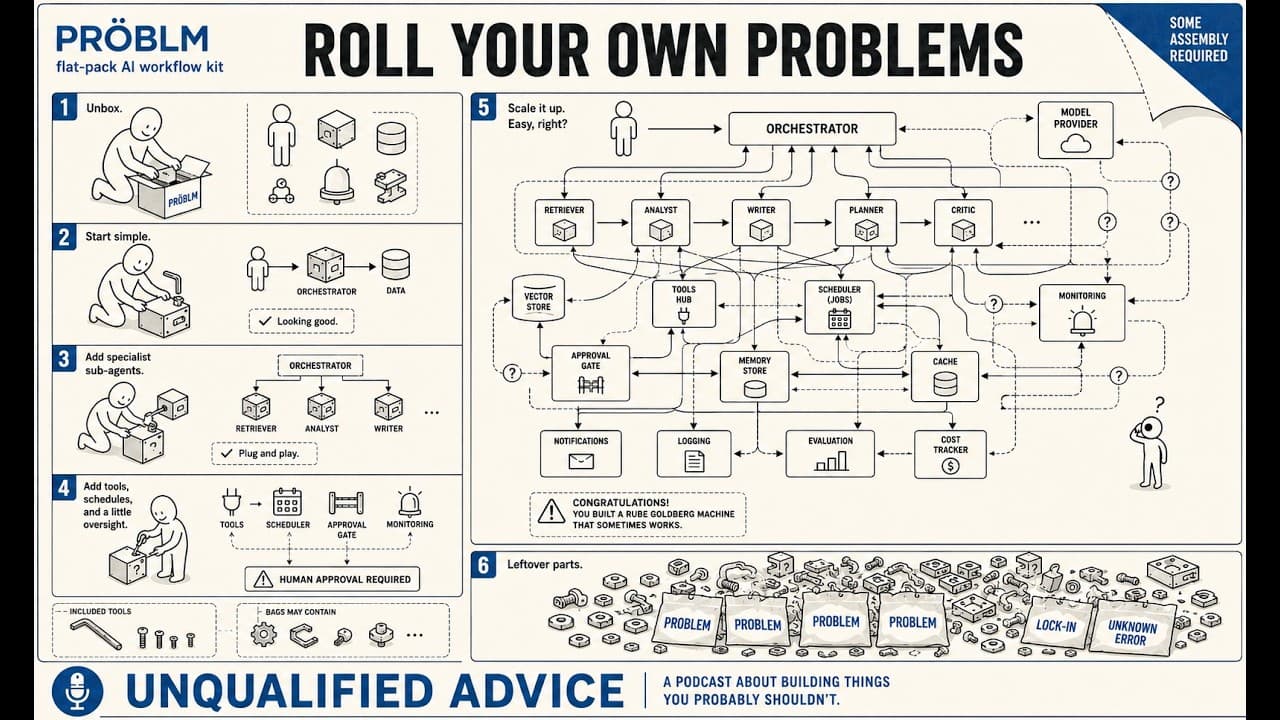
48:42Roll Your Own Problems
Aug 24, 2026
The 7:30 PM Tuesday Problem This one starts with a website. I finished rebuilding Howard Home Realty — Lindsay Howard's brokerage — and it went live the morning we recorded. Twenty-five hours all in, most of it alongside Claude. Dan immediately turned my side project into a tip that's going to change how I work: extend your Claude Code transcript retention before it auto-deletes, then mine all of it into a repeatable playbook for the next time. From there we get to the spine of the episode. Dan fired a software vendor — a product he paid for stopped working and they chose not to tell him — and he's building the replacement himself. So we've both got a build project going, and we circle the same caution: it is a great moment to roll your own solutions, and you want to be very careful about rolling your own problems. On some Tuesday at 7:30 PM the thing breaks, it's yours, and there's nobody to call. Then Dan asks whether AI is a deflationary technology and I fumble it live. I'm leaving the fumbling in. He gets there in one sentence — you get more for less, period — and his carve-out forty minutes later is the part I'm still chewing on: deflationary everywhere except the one place all the money is going. That opens the labor half — a soft jobs print, a read on the new Fed chair, and the question of the episode: what is actually inside the manufacturing number? Dan handed that one to Claude on the record. His instinct was right and his follow-up guess was not. Go out, build something this week. MENTIONED: Claude, Claude Code, Cowork, Claude Tag, Fable, Codex, Copilot, Buzz, workgroove.ai, HQ, Anthropic, OpenAI, Microsoft, Meta, Block, Google, Goldman Sachs, Morgan Stanley Howard Home Realty — the cross-link I promised on air https://www.howardhomerealty.com/ UNQUALIFIED FACT-CHECK We said some things. Here's how we did. 🟢 = Nailed it | 🟡 = Close enough | 🔴 = Whiffed it 🟢 The jobs print really was bad — worse than Dan said Payrolls FELL 23,000 against consensus of roughly +83,000, with May and June revised down a combined 103,000. 🟡 "We added two hundred ninety five thousand jobs" No month in 2025 or 2026 hit 295,000; closest was December 2024 at +256,000. The phenomenon was real, the number is a composite of a memory. 🟡 Philippine jobs up eleven percent quarter over quarter Actual was about two percent. Real kernel: BPO grew ~4% in 2025 to ~1.9 million workers, which does violate the AI-guts-outsourcing story. 🔴 Warsh is riding a deflationary AI wave The "structurally disinflationary" line predates his confirmation. As Chair he's said the opposite — AI capex "is driving up prices of memory and logic chips" — and took three hawkish dissents. Dan IS right that the cagey narrative is real. 🟢 Meta is training electricians and plumbers America's Workforce Academy, June 2026: $115 million, free five-week program with housing and a stipend, job guarantee, tied to a ~$600 billion data-center buildout. 🟢 Trades don't show up in the manufacturing number Dan's on-air question, and the answer is definitional. Manufacturing is NAICS 31-33; electrical and plumbing contractors sit in Construction. A crew wiring a hyperscale campus can never appear in manufacturing payrolls. 🔴 The two thousand electricians don't all go to zero Meta's Hyperion campus peaks near 7,500 construction workers and settles at roughly 1,000 permanent jobs. The 2,000 figure is fair; the stickiness isn't. 🟡 College enrollment plummeting, U of A down twenty percent That 23% figure was FIRST-YEAR enrollment; total was down about 2.7%. Nationally, enrollment ROSE about one percent in fall 2025. 🟢 Elementary schools are closing for lack of kids US fertility hit an all-time low of 1.599 in 2024. Public K-12 fell from 50.8 to 49.4 million by 2024, projected below 47 million by 2030. 🟡 "Buzz, just released by Jack Dorsey" Announced July 2026, but built by Block, not a personal project. The agent-native architecture is real; it's also pre-1.0. Final Score: 4 green, 4 yellow, 2 red Dan sweeps the trades round and drops the Fed round. I stapled a fresh number to the wrong noun. CHAPTERS 00:00 - Cold Open: Rolling Your Own Problems 00:23 - A Client Site, Live That Morning 03:59 - Dan's Tip: Stop Letting Your Transcripts Auto-Delete 08:06 - What Squarespace Does For You That You'll Now Do Yourself 12:33 - So Would You Call It a Deflationary Technology? 16:32 - The Agent Layer Becomes the Operating System 17:57 - When a Vendor Won't Tell You It's Broken 20:10 - A Tech-Support Agent for a Client Who Isn't Technical 24:58 - Advice for the Cohort Booing AI at Graduation 27:56 - Okay, Bug Brothers, You Got the Job 30:21 - Your Own Personal Chief of Staff 36:20 - Fable, Token Budgets, and Hashtag Skill Issue 38:43 - The Jobs Print Nobody Wanted 40:11 - What's Actually Inside the Manufacturing Number? 45:38 - Best in the Long Run, Painful in the Short 46:54 - The Airplane's in the Air, I'm Still Putting the Rivets In
 1:05:49
It's Memes that Keep Us Together
Aug 17, 2026
Dan cracked open a Lego set he'd abandoned two and a half years ago at bag six of twenty — and neither of us knew the Legos would come back at the end of the hour and quietly explain the whole episode. Then he brought the Fed, and the best reframe we've had in a while: everyone says Warsh is ruining Fed independence, Dan thinks he's protecting it. From there — the US Treasury behind the yen, whether fewer FOMC meetings is opacity-as-cowardice or opacity-as-strategy, the SEC's push toward semi-annual filings, and me pulling up a chart live in order to be wrong about mortgage rates by a full calendar year. The middle is a build episode: the backend I stood up for the site, Dan's Shopify agent work, and the sentence I keep coming back to — "it requires you to get good at something that you no longer have to get good at." A few minutes later he finishes the thought: "But now the agent knows both." We land in agentic commerce, disagree about whether consumers or businesses hand over the credit card first, try to found a Fastenal competitor and abandon it inside ninety seconds, and end up wondering whether the AI winners are the companies already sitting on enormous physical infrastructure. Then Zeihan, gated communities, and what's left of the nation-state — until Dan hauls us back with the Legos. Use the frightening forecasts as instructions and play sets, and don't be afraid to break them apart. None of this is architecture. It's behavior, all the way down. It's memes that keep us together — and that should make you feel better, not worse, because it means it can change. Go get the reps in. Cheers, Sean BOOKS DISCUSSED Stress Test by Timothy Geithner The End of the World Is Just the Beginning by Peter Zeihan Geopolitical Alpha by Marko Papic Also: The Prince, Dune, Red Rising, The Iliad LINKS Kabu — Dan's Japanese equity research platform https://getkabu.com UNQUALIFIED FACT-CHECK We said some things. Here's how we did. 🟢 = Nailed it | 🟡 = Close enough | 🔴 = Whiffed it 🟢 The US Treasury really did back the yen. July 31, 2026 — the NY Fed acting as agent for Treasury's Exchange Stabilization Fund, alongside Japan's MoF. Dan even got the institutions right. 🟡 "He wants to get rid of the September meeting." Warsh did float cutting eight FOMC meetings to six plus two. Nobody proposed killing September — it's still on the calendar. 🔴 The yen carry trade is "the widowmaker." That's the JGB short. Different trade, same family. 🟡 "Mortgage rates started the year at 6.8–6.9%." They opened 2026 at 6.16%. That was January 2025. And they did go below six — 5.98% in February. 🟢 The SEC really is pushing semi-annual filings. Form 10-S, proposed May 5, 2026, optional. Estimated savings: $198K per issuer per year. 🟡 "Voting machine now, weighing machine later." Graham and Dodd wrote the metaphor in 1934. The short-run/long-run version is Buffett's. 🟡 Geithner as "lead point man" on the Asian crisis. He was Treasury's Assistant Secretary — central, but Rubin and Summers ran it. 🟢 The Geopolitical Cousins four-way. Shapiro and Papic, Eps 73 and 74 with Gertken and Zeihan, four days and two days before we recorded. 🟡 Zeihan's "sequel." He is writing — a novel. Acceptable Range, first of a trilogy, early 2027. 🟡 Shopify "trading at 115 EPS." That's the P/E. EPS was $1.02. It hit an all-time high nine months earlier, then jumped 17% three days after we recorded. 🟢 The Mag 7 really are pouring it into hard infrastructure. Goldman models AI capex at $755B in 2026 and $920B in 2027 — now debt-funded rather than paid out of operating cash flow. 🔴 "Below 4.3 stars on Amazon and you're screwed." No cliff there. The sweet spot is 4.2–4.5, and a perfect 5.0 converts worse. 🟡 "Three is normal in Japan or Germany." Japan yes. Germany no. Final Score: 4 green, 7 yellow, 2 red Two guys who read a lot, one chart open between them. CHAPTERS 00:00 - Cold Open: It's Memes That Keep Us Together 00:21 - Lego Sets, Space Pirates, and Open-Ended Play 04:31 - Warsh Holds, the Fed Dissents, and Nobody Knows Why 07:58 - The $100K Truth Social Feed 10:12 - Quarterly vs. Semi-Annual: Who Earns the Premium? 13:48 - Mortgage Rates, Tariffs, and the Bond Seesaw 16:22 - Japanese Equities, the Yen, and the Widowmaker 21:22 - Geithner, the Asian Crisis, and the Reading Queue 22:21 - Truth in Ratings: Amazon, Goodreads, Grade Inflation 27:18 - What Sean Built: A Backend and a Book Library 31:43 - Staying in the Driver's Seat 36:13 - Just Build Something (and Throw It Away) 39:05 - Legible Process Knowledge vs. Taste 40:51 - Shopify and the Arrival of Agentic Commerce 47:24 - Can We Build the Fastenal Competitor? 48:43 - Physical Infrastructure Is the AI Trade 50:45 - Zeihan, Geopolitical Cousins, Holding Ideas Lightly 53:26 - Gated Communities and the Nation-State Question 57:17 - Models Aren't Reality — It's Memes That Keep Us Together 58:56 - Notion as the Agent's Brain 1:02:15 - Voice Agents, Codex, and Picking the Right Interface
 46:27
46:27You Have Died from Excessive Chatbotting
Aug 10, 2026
Hello dear show notes readers! Substack spent the week scanning everyone's prose for robot fingerprints with Pangram, the AI detector now built into the platform. We discuss the uncomfortable truth that a word-order detector can tell you how something was written but not if idea is any good. Dan's warning: the incentives now point toward machine versus machine, writers slopping up their prose so other robots can't tell a robot helped, and readers throwing out very good essays on principle. AI should make you think harder, not think for you. I walk through the agent I talk to on my commute, Number One, and Dan counters with his council of five advisors that occasionally blows up an essay he was sure about. We talk about when companies skip the thinking part entirely: congratulations, you just hired one million terrible employees. The back half gets personal, as we ask what happens when the machine reads you? Personality tests, a suspiciously accurate inference of my IPIP scores, an app that accused Dan of camouflaging, and the mirror problem: tune this thing to your feedback carelessly and you've built a digital echo chamber with a population of one. Dan closes by comparing the whole technology to the Force, and honestly, it holds up better than it should. Use the force and go build something this week. Cheers, Sean Dan's Substack: https://prometheusdispatch.com UNQUALIFIED FACT-CHECK 🔍 We said some things. Here's how we did. 🟢 = Nailed it | 🟡 = Close enough | 🔴 = Whiffed it 🟢 Substack really did unleash Pangram this week The partnership launched July 21, 2026 — readers can scan posts, notes, replies, and comments over 100 words; creators can pre-scan drafts and dispute results (Axios, Jul 23). 🟢 Pangram is the cream of the crop, by a good mile A June 2026 Vrije Universiteit Brussel evaluation found only Pangram produced satisfactory results (97.5% detection on fully-AI text, 0% false positives on ESL essays) while GPTZero, Turnitin, and Copyleaks whiffed; a University of Chicago study concluded Pangram "dominates the other detectors." 🟡 The Beast handbook says record 100 episodes, then come talk to me The advice is real and Sean's paraphrase is dead on — MrBeast: "make 100 videos and improve something small with each video." It comes from MrBeast's social posts and interviews, not the leaked 2024 production handbook (an internal onboarding doc). Sean flagged his own fuzziness. Half credit, fifty episodes to go. 🟢 Both sides of the Atlantic are half on fire Hyperbole licensed: by early July, Colorado had air-quality advisories on 22 of 64 counties and Denver briefly ranked worst air in the US (CPR, Jul 7). The week of recording, wildfires in France and Spain forced 250,000+ evacuations amid a record heat wave (CNN, Jul 25). 🟢 Death by wildfire smoke and diarrhea lettuce — same week, both real NASA tracked Canadian wildfire smoke into the US July 14–20, 2026, and Taylor Farms recalled its shredded iceberg lettuce July 17 amid an outbreak with 4,000+ CDC-confirmed cases. The meme was documentary. 🟢 Andrew Wilkinson's Deep Personality app All confirmed: created by Wilkinson, roughly an hour of questions, output includes a compact prompt approximating your scores across a battery of personality instruments — vibe-coded with ~$5,000 of Claude credits to replace "tens of thousands of dollars of psychological evaluations." 🟡 Every Bible was written by a scribe, then Gutenberg, then a thirty years war The causal thread — print breaks the scribal monopoly, upheaval follows — is a respectable historian's argument. But the Thirty Years' War began in 1618, about 170 years after Gutenberg, with a Reformation in between. Directionally great, chronologically compressed. 🟢 INTJs are the architects (and the Big Five is the scientific one) 16Personalities does brand INTJ "The Architect," and Dan promptly outed himself as one. Final Score: 6🟢 / 2🟡 / 0🔴 When the week's news is "the lettuce is dangerous and everything is on fire," accuracy is easy — the machines fact-checking us have never had less to do. 00:00 - Cold Open: Did Anthropic Steal a Street Artist's Color Scheme? 02:37 - Substack Unleashes Pangram: AI Detection Comes for Writing 06:29 - Style Isn't Substance: What a Word-Order Detector Can't Score 09:28 - Oregon Trail, 2026 Edition: Wildfire Smoke and Diarrhea Lettuce 11:08 - AI Should Make You Think Harder 13:40 - Sean's Commute Agent: Daily Briefs and Audio Journaling 17:23 - Dan's Council of Five Advisors 21:14 - The Gen X Opportunity: Build a Version of Yourself 24:54 - Cleaner Agents: Never Disrespect the Janitor 29:48 - Voice DNA: Staying You at the Point of Generation 32:56 - Gutenberg, Genies, and Machines Reading Machines 36:43 - Hire a Transformation Agent, Not Another IT Person 40:28 - What Agents Do You Bring With You? 42:43 - Personality Tests: INTJs, IPIP, and Deep Personality 48:35 - AI Therapy and the Mirror Problem 51:05 - The Force: A Dual-Use Invitation
 58:04
58:04Gen Why-Am-I 40?
Aug 3, 2026
The New Midlife Menu Dan walked in with a Substack essay and an idea rattling around his head: the millennial midlife crisis is going to be a barbell. The boomer version had memorable flavors — the sports car, the affair, the divorce. So what does ours taste like? We ran the menu: either quit drinking or take up alcoholism, run a marathon, take peptides and Hyrox (whatever that is), get on OnlyFans, have a panic baby, and finally go all-in on the side hustle — 100% of your private life online. Does any of it answer the real question: did I choose this, or did I just wake up here? We detoured to Kings Island — a stomach-twisting Midwest reunion — which reopened our hunger for in-person stuff we'd have shrugged off a decade ago. That folded into homogenization; when it comes down to it, we're a society of apes and mimics, and good ideas spread whether you like it or not. Then: is access becoming the moat? The F1 paddock, the box seats, the country-club membership aren't about friendship; they're where business gets done. You're not bidding against people, you're bidding against a balance sheet: you vs. the S&P 500 for the hot tickets, which means fewer friends at the events. And because it's us, we spent a stretch on SpaceX — down ~40% since the IPO, my hand itching near the falling knife — via a Maxinomics breakdown on Starlink and launch economics — satellite spectrum as real estate in the sky. One of my central beliefs: despite being a mechanical engineer, I know you can't escape Ohm's law — you need a little voltage across society to drive any current. Without a real difference between top and bottom (and the genuine risk of losing your station, Premier-League-relegation style), nobody's charged-up enough to build anything. Cheers, Sean LINKS & REFERENCES "The Millennial Midlife Crisis is Going to be a Barbell" (Priyanka Desai) https://pridesai.substack.com/p/the-millennial-midlife-crisis-is Maxinomics — the SpaceX breakdown https://www.youtube.com/@Maxinomics UNQUALIFIED FACT-CHECK We said some things. Here's how we did. 🟢 = Nailed it | 🟡 = Close enough | 🔴 = Whiffed it 🟢 Cedar Fair merged with Six Flags Sean said Kings Island's former parent, Cedar Fair, "recently merged with Six Flags" (and flagged his own uncertainty). Correct — the merger of equals closed July 1, 2024, and the combined company took the name Six Flags Entertainment Corporation. Nailed it. 🟢 Blue Origin is separate from Amazon Sean guessed Amazon might own Blue Origin; Dan corrected him — "he sells Amazon stock in order to put more money in Blue Origin." Right. Blue Origin is Bezos's privately held company, funded largely by his Amazon stock sales, and is not part of Amazon. 🟢 SK Hynix is building a massive plant in Indiana Sean described an SK Hynix factory across from where his grandmother lived. Real — a ~$3.87B advanced-packaging/AI-memory facility in Purdue Research Park, West Lafayette; billed as the largest single development project in Indiana history. 🟢 Eli Lilly's Lebanon plant is enormous and thirsty Sean placed a giant Lilly plant near Lebanon with serious water demands. Correct — the LEAP District buildout runs into the billions, and the proposed 50-mile pipeline to pull Wabash-aquifer water became a real controversy. 🟢 Messi is 39 Sean: "he's thirty nine." Lionel Messi was born June 24, 1987, so he turned 39 weeks before we taped. Nailed it. 🟡 Launch costs "$800,000 per kg down to sub-$100" Dan, relaying Maxinomics. The story — an order-of-magnitude cost collapse — is right, but the numbers are off. The Space Shuttle ran ~$54,500/kg; Falcon 9 is ~$2,700/kg today (~95% reduction). "Sub-$100/kg" is the aspirational Starship target, not the current price. 🟡 "Facebook's had multiple 80% drawdowns; Amazon was down 90%" Amazon is spot-on — it fell ~90-95% in the dot-com bust. Facebook/Meta is a stretch: worst drawdown ~75-77% (2022) plus a ~53% dip after the 2012 IPO — not "multiple 80%" declines. Half credit. 🟡 "Sixty million people added to the country in the last twenty years" Close but high: the U.S. grew ~296M (2005) to ~344M (2025), about 47.6M over 20 years. Sixty million is closer to a 25-year figure. 🔴 Amazon's market cap is "around 1.1 trillion this week" Off by more than half — Amazon sat around $2.66 trillion in July 2026. The $1.1T figure is a couple of years stale. (He was riffing without a screen open.) Final Score: 5 green, 3 yellow, 1 red Five clean hits, three "right idea, shaky digits," and one market cap from a bygone era. Solid outing for two guys taping before a soccer match.
 49:17
49:17The Easiest $250 I've Ever Lost
Jul 27, 2026
Easy Come, Easier Go Happy 250th, America! I spent the Fourth in Dallas watching Egypt and Australia go to penalty kicks in front of 70,000 people — nothing like getting full value for the ticket — and in our increasingly small world, randomly found an Egyptian coworker in the crowd to celebrate with. Then I opened Kalshi for the first time and put $250 on the US to win the whole thing. In honor of the 250th birthday, naturally. Four percent odds, five minutes to place. Disturbingly easy. Meanwhile Dan couldn't figure out which of three Fox apps would actually show him the game. He put it perfectly: you can't easily pay to WATCH the World Cup, but you can bet on it in seconds. The title tells you how the trade went. Dan also files a formal appeal on a fact-check yellow card (ruling below), and we tour our new website's scorecards (unqualifiedadvicepodcast.com) — we're holding up around 85% on facts. Then the most practically useful AI talk we've had in a while: with Fable back in our hands for the weekend, Dan's playbook is to make it the architect. Plus: Dan's $225,000 basement-rig quote, parabolic memory prices, and the strange norm-reversal where the US government gates model access like a state secret while China open-sources everything in sight. Dan's fix: if the government takes stakes in frontier labs, twelve-month-old models go open source by default. The American people paid for them. Postscript from the editing desk: Belgium 4, USA 1. Spain won it all. Easiest money I've ever lost. Stay frosty, and go build something. — Sean UNQUALIFIED FACT-CHECK 🔍 🟢 = Nailed it | 🟡 = Close enough | 🔴 = Whiffed it 🟢 ~71,000 at Egypt–Australia. Official sold-out attendance: 70,244 at AT&T Stadium; 1-1, Egypt through 4-2 on pens. Nailed it. 🟢 The Kalshi math. One-in-sixteen "straight math" is exactly 6.25%, and $250 at 4¢ pays $6,250 — the transcript's "60,500" is a machine mishearing "sixty-two fifty." We score the math, not the microphone. 🟢 Memory prices went parabolic. DRAM contract prices rose 50–55% QoQ into Q1 2026 (some segments +80–90%); Micron is sold out for 2026. 🟢 Etched. Real and as described: Gavin Uberti (Harvard dropout, twenties) and Rob Wachen; transformer-specialized Sohu chip; Invest Like the Best EP.480; exited stealth June 30, 2026 with $800M raised and $1B+ in contracts. 🟡 1.4nm chips, "current is 3nm." Samsung and Intel are working on 1.4nm-class nodes (2029 and ~2027 targets) — but TSMC entered volume 2nm production in late 2025, and node names are marketing labels, not literal transistor sizes. 🟢 The elevator operator. Matches James Bessen's finding: of 270 occupations in the 1950 census, exactly one was eliminated by automation. 🟡 "Computers made more bookkeepers and accountants." Half right: accountants and auditors grew, bookkeeping clerks declined as spreadsheets ate the data entry. 🟢 1929 ran on radio and aeronautics. Correct — RCA and the post-Lindbergh aviation boom were the glamour techs of that bubble. 📋 APPEALS COURT: Dan's prior 🟡 ("54 cents of every Amazon dollar goes to Amazon") is upgraded to 🟢 on appeal — his figure comes from a US-sellers-only dataset, a higher-cost cohort than the ~50% global headline number. Survey scope matters; noted for future rulings. 🗓️ BONUS: Sean said he attended the match "on Saturday." It was Friday, July 3. Long weekend, penalty kicks, we forgive. FINAL SCORE: 6 🟢 / 2 🟡 / 0 🔴 The facts survived the weekend better than the $250 did. CHAPTERS 0:00 - Cold Open: A Server Rack or a Porsche 0:37 - Happy 250th: A World Cup Fourth in Dallas 2:35 - The Easiest $250: Betting on the USA 4:07 - Easier to Bet Than to Watch 6:55 - Dan's Midwest Loop & a Tornado's Path 9:17 - The Appeals Court: Dan Contests a Yellow Card 11:28 - The Website & Our Scorecards 13:39 - A Weekend with Fable: Hire the Architect 17:20 - Local Models: Qwen, Gemma, GLM 18:43 - Reversed Norms: Gated Models vs. Open Source 21:30 - The $225,000 Basement Rig 25:10 - Etched: First-Principles AI Hardware 27:32 - 1.4nm and the Edge of Moore's Law 28:58 - Rethinking CS: Freshman Year in the CEO's Office 32:15 - AI Fear, Elevator Operators & Lost Training Grounds 39:52 - 10x People and the Inequality Narrative 41:55 - Boom or Bubble? Radio, Aeronautics & AI 44:30 - Should Everyone Own Stocks? 46:18 - Exclusivity as the Product 47:56 - Stay Frosty, Go Build Something LINKS Unqualified Advice — scorecards & back catalog https://unqualifiedadvicepodcast.com Invest Like the Best EP.480 — Etched https://open.spotify.com/episode/5Um7scoixVAABKaAzy3Khv Maxinomics (Phil Andrews) https://www.youtube.com/@Maxinomics Kalshi https://kalshi.com
 55:52
55:52There Is No Such Thing As Free Admission
Jul 20, 2026
Talking to God for a Couple of Days I came into this one fresh from a roaring World Cup fan fest in Houston where Team USA put four past Paraguay and I found a new third place. Dan and I dig into what that communal energy actually costs: who pays for security (FEMA and Texas, which means we already did), who profits (FIFA), and why it's so hard to build that shoulder-to-shoulder feeling in a country designed for cars. We wander from European piazzas to American sprawl to whether self-driving cars quietly make sprawl worse, and land on the third place — how fragile and expensive it's become to just be around other people. Then it's a proper grab-bag: the great game of mega-event ticket pricing (you can't repeal supply and demand, no matter how unfair $10k nosebleeds feel), the SpaceX IPO I missed by four days (tiered lockouts, $2T at 100x sales, voting with your heart vs. weighing with your head), and Dan's lockout-timed options play. And then the part that named the episode: for about two days, a handful of institutions got their hands on Fable — the nerfed-and-released version of Anthropic's Mythos model — before the government clawed it back. Dan torched ~$18k of tokens in 48 hours. We get into treating a model like a munition, why diffusion happens anyway, and why we're both tempted to just put a box in the basement and run a model we own. The model is the commodity; the hardware is the value. Cheers — and go build something that lets you touch more grass. Sean BOOKS DISCUSSED Reminiscences of a Stock Operator by Edwin Lefèvre Book: https://en.wikipedia.org/wiki/Reminiscences_of_a_Stock_Operator Author: https://en.wikipedia.org/wiki/Edwin_Lef%C3%A8vre LINKS & REFERENCES Maxinomics — the Live Nation/Ticketmaster antitrust breakdown Dan recommends https://www.youtube.com/@Maxinomics 2026 FIFA World Cup — 104 matches, June 11–July 19, 2026 https://en.wikipedia.org/wiki/2026_FIFA_World_Cup Triple Crown of Motorsport — Monaco GP, Indy 500, Le Mans https://en.wikipedia.org/wiki/Triple_Crown_of_Motorsport UNQUALIFIED FACT-CHECK 🟡 "Goes through July eleventh, a hundred and four games." The match count is right (104), but the tournament runs June 11–July 19, 2026 (final at MetLife). "Almost a month" is correct — it's about five and a half weeks. 🟡 "FIFA's gonna rake in about twelve billion." In the ballpark: tournament revenue estimates are ~$9–11B; the full 2023–2026 cycle is near $13B. $12B blends the two. 🟢 "The first eighth and the last eighth are always the most expensive." Correctly attributed to Reminiscences of a Stock Operator. Don't try to catch the exact bottom or top. 🟢 "The Triple Crown is Monaco, Indy, and Le Mans." Correct. Graham Hill is still the only driver to win all three. 🟢 "Porsche put the ignition on the left so drivers could start while running to the car." True — a genuine nod to the old Le Mans running starts. 🟢 "Mercedes left Le Mans after their car went airborne." True — after the CLR flipped at speed in 1999, Mercedes pulled its prototype effort. 🟡 "Amazon and Facebook had 80–90% drawdowns." Directionally true and a great point, but loose: Amazon did fall ~90%+ and recover; Meta's worst stretches were closer to ~50–75%. The lesson holds; the matching percentages don't. 🟡 "Toby Lütke races an LMP2 car on a bronze license." Lütke is a real, serious amateur racer, so the spirit's right; the exact class/license detail we'd want to confirm. Note: the SpaceX IPO mechanics and the Fable/Mythos/Project Glasswing storyline were live and fast-moving — treat the specific numbers as our best read on the day, not gospel. Score: 5 🟢 / 4 🟡 / 0 🔴. A clean week — the misses are date-and-decimal stuff, not blown calls.
 55:43
55:43No Movies About the Maintenance Team
Jun 22, 2026
The Averaging Machine Dan's wife and kids were off camping leaving him time to watch the whole of Glengarry Glen Ross in a single sitting. Why does nobody make movies like that anymore? Scale homogenizes. Once a film has to sell in China and Germany and everywhere at once, it gets sanded down to the middle. Dan claims that AI is the same kind of averaging machine globalization always was. I say the same corporate dispersion that flattens taste also spreads it. I pulled into a new Chinese chain half a mile from the plant in Texas, sat down, and it tasted exactly like what I ate in Chengdu. You don't get that without a machine pushing it outward. Homogenization and discovery are the same engine running in two directions. The back half turned macro. Dan walked through his Amazon Prime Day strategy: pulling ads to zero while everyone else bids each other into the ground, taking a worse revenue number for a much better profit one. You win by managing the downside, not chasing the upside. Then the paper-cuts of inflation: a little tariff, a little fuel, a little Hormuz, and a tungsten-carbide problem most people will never hear about that's quietly tripling my industry's tooling costs. Each piece feels transitory, but what if the sum is sticky? Which got us to Warsh taking the Fed chair and a genuinely fun thought experiment: if today's inflation is mostly a supply-side problem, does hiking rates actually make it worse? Go build something this week. — Sean SHOWS / FILMS DISCUSSED Glengarry Glen Ross (1992) — dir. James Foley, written by David Mamet; Lemmon, Pacino, Baldwin, Harris, Arkin, Spacey https://en.wikipedia.org/wiki/Glengarry_Glen_Ross_(film) A Few Good Men (1992) https://en.wikipedia.org/wiki/A_Few_Good_Men The Hunt for Red October (1990) — referenced for Baldwin's prime https://en.wikipedia.org/wiki/The_Hunt_for_Red_October_(film) Scent of a Woman (1992) — referenced for Pacino's heavy-hitting years https://en.wikipedia.org/wiki/Scent_of_a_Woman_(1992_film) LINKS & REFERENCES YGF Malatang, Katy TX — the YangGuoFu spot Sean stopped at https://www.ygfmalatangkaty.com/ Derek Thompson — AI-and-cognition interview https://www.derekthompson.org/ Dan Wang, Breakneck — America as a "lawyerly state" https://danwang.co/ Kevin Warsh — newly confirmed Fed Chair https://en.wikipedia.org/wiki/Kevin_Warsh Berkshire invests $10B more in Alphabet (CNBC, June 2026) https://www.cnbc.com/2026/06/01/berkshire-hathaway-alphabet-investment.html The midwit meme (IQ bell curve) https://knowyourmeme.com/memes/iq-bell-curve-midwit Chinese tungsten prices surge on export controls (Fastmarkets) https://www.fastmarkets.com/insights/chinese-tungsten-product-prices-surge-2025-export-controls-fresh-demand/ UNQUALIFIED FACT-CHECK We said some things. Here's how we did. 🟢 = Nailed it | 🟡 = Close enough | 🔴 = Whiffed it 🟢 The Glengarry Glen Ross roll call. Lemmon, Pacino, Baldwin, Harris, Arkin, Spacey, Pryce. All correct. One room and a lot of rain, so the actors were the budget. 🟢 Baldwin "after Hunt for the Red October," Pacino "Scent of a Woman timeframe." Both sharp. Hunt for Red October (1990) had Baldwin as Jack Ryan; Scent of a Woman (1992) is the same year as Glengarry and won Pacino his Oscar. 🟡 "54 cents of every dollar goes to Amazon." Dan flagged he's more efficient. The widely-cited figure (Marketplace Pulse) is that Amazon's total take — referral + FBA + storage + ads — reaches up to ~50% of seller revenue. 54% is plausible for a large-seller sample, a hair above the headline; it's per-seller-revenue, not per-consumer-dollar. 🟢 China is "playing with the APT market" and carbide costs spiked. Correct, and Sean was conservative. China's tungsten export controls hit Feb 4, 2025; Chinese tungsten prices rose 200%+ through 2025 and the European APT benchmark was up ~557% by March 2026. His "3x since August" understates it. 🟢 Warsh is confirmed and in the seat. Senate confirmed him 54–45 on May 13, 2026; sworn in replacing Powell. He's a Hoover Institution fellow, so the interview checks out. 🟢 Berkshire put ~$10B into Google, a small slice of cash. Confirmed (CNBC, June 1, 2026), bringing the total Alphabet stake to ~$26.6B. The "$400 in your pocket, invest $10" analogy holds; "free call option on AI" is a fair read. 🟡 "Donut theory" of interest rates. Sean admitted he couldn't recall the source. No established term by that name, but the intuition overlaps with neutral-rate (r-star) reasoning and the fiscal channel. Scoring the instinct as defensible, the label as a Sean original. Final Score: 5 🟢, 2 🟡, 0 🔴.
 50:20
50:20Gone Building
Jun 15, 2026
Hello dear show notes readers! This week I ask Dan if he's been building anything lately, and we spend the hour discussing the ins and outs of building new tools and products. Two guys, exploring niches. That's the whole episode. Dan is launching Kabu (kabu research on Substack, link below) — a paid newsletter and model portfolio centered on small/mid-cap Japanese equities, anchored on the post-Shinzo-Abe governance reforms and ~2,000 names nobody covers in English. We get into tier pricing, what makes a paid Substack worth paying for, and the practical compliance hygiene around publishing investment ideas (Dan reaching for Lowe v. SEC — the fact-check below rewards him for it). I fill Dan in on the real estate brokerage site I've been making for past guest and current business owner Lindsay Howard, and a property-tax-allocation audit tool I had a vision for. That kicks us into the bigger question hiding underneath: when one citizen with a laptop can audit a municipal budget, what changes? Dan is bullish on the ground-up version. We're both eyes-open about the pitchfork version. Carve-outs: How to Win a Trade War (Keynes & Bown — the pirate-ship / warship / merchant-ship taxonomy alone is worth it); Hamming's The Art of Doing Science and Engineering on AI and human uniqueness; and Patrick Radden Keefe's London Falling, The Snakehead, and the Wind of Change podcast. Go build something this week. Cheers, Sean Books Discussed How to Win a Trade War by Soumaya Keynes and Chad P. Bown https://www.simonandschuster.com/books/How-to-Win-a-Trade-War/Soumaya-Keynes/9781668221310 The Art of Doing Science and Engineering: Learning to Learn by Richard Hamming https://en.wikipedia.org/wiki/The_Art_of_Doing_Science_and_Engineering London Falling by Patrick Radden Keefe https://www.penguinrandomhouse.com/books/704979/london-falling-by-patrick-radden-keefe/ The Snakehead by Patrick Radden Keefe https://www.patrickraddenkeefe.com/ Links & References Maxinomics on YouTube (Phil Andrews) https://www.youtube.com/@Maxinomics Kabu Research on Substack — Dan's Japanese equities newsletter https://kaburesearch.substack.com/ Citrini Research https://www.citrini.com/ Wind of Change podcast (Patrick Radden Keefe) https://www.pineapple.fm/wind-of-change Unqualified Fact-Check 🟢 = Nailed it | 🟡 = Close enough | 🔴 = Whiffed it 🟢 SLB rebrand ~4 years ago. Schlumberger became SLB in Oct 2022. 🟢 Hamming worked on the Manhattan Project. Confirmed — Los Alamos 1945, then Bell Labs 1946. Turing Award 1968 for error-correcting codes. 🟢 Wind of Change is real. Keefe, Pineapple Street Studios, 2020, eight episodes on whether the CIA helped write the Scorpions song. 🟡 5% of US tractor-trailers are flatbeds. ATA / FTR data puts the share at 5–8% depending on the cut. Directionally right. (Also: it's Maxinomics, not "Maximomics." Phil Andrews, not "Max.") 🟡 France requires 75% of your estate to your kids. The réserve héréditaire scales: 50% for one, 66% for two, 75% for three or more. Dan's directional point is right; the math is off. 🟡 "You can't trade ten days after publishing — Lowe v. SEC." Right case. Lowe v. SEC, 472 U.S. 181 (1985) established that bona fide investment newsletters aren't "investment advisers" under the 1940 Act — the §202(a)(11)(D) publisher exemption that shields kabu research, Citrini, TSOH. Lowe itself doesn't set a 10-day window; that's the compliance hygiene publishers observe to stay within the exemption. Companion anti-scalping doctrine: SEC v. Capital Gains Research Bureau (1963). Dan's instinct (pre-publish exits) is what keeps you protected. 🟡 "Chad Brown." It's Chad P. Bown (no E). Sean's forgiven. 🟢 The Snakehead covers Cheng Chui Ping (Sister Ping) and Chinatown smuggling 1984–2000, with the 1993 Golden Venture grounding as the inflection. Keefe, Doubleday, 2009. Final Score: 4 green, 4 yellow, 0 red. Dan had the right case (Lowe v. SEC) — the transcript robot just heard "low V SEC" first.
 50:23
50:23Frameworks in the Atom Economy
Jun 4, 2026
This week Dan and I open on Jensen Huang's leather jacket on the Anchorage tarmac and slide into what actually happened at the Trump–Xi summit. The deliverable was frameworks, not specifics: no signed deals, but a tentative agreement to stand up a bicameral US-China trade council to replace what we ended up calling "trade agreements by tweet." Underneath the framework talk is the admission. The US and China formalizing a direct two-party institution with Russia visibly excluded — "you're a menace, but you ultimately don't matter" — reads as the moment somebody said the bipolar world out loud. The choke-point math makes it real: 20 percent of global oil through Hormuz, half of global container traffic through Taiwan, and the UAE laying pipe to route around the first one. From there we end up building material for our Promethean candidate. Dan introduces a frame I think we'll be reaching for again: the atom economy. The bits era is over; atoms are next. Energy grid, sensor networks, smart-cooling infrastructure as the public-infrastructure backbone everyone plugs into. I revive the six-year single-term presidency idea, this time with industrial-policy continuity as the rationale. Then somehow we wind up in the deep dark forest of US sales tax administration. Dan files 48 times a month across nested Colorado jurisdictions. We wander through Abe Campbell's tax-overhaul tweet, Charlie Munger's "show me the incentives," and a serious-but-still-speculative pitch for a federal sales tax with tiered consumption rates — zero on staples, escalating to a hundred on Birkin bags. Thanks for sticking with us. Go build something. — Sean Books Discussed Why Nothing Works by Marc J. Dunkelman https://www.hachettebookgroup.com/titles/marc-j-dunkelman/why-nothing-works/9781541700215/ Companies Discussed Nvidia, Walmart, Intuit, H&R Block, TurboTax, Nest (Google), Rolex, Hermès LINKS & REFERENCES EIA petroleum chokepoint analysis: https://www.eia.gov/international/analysis/special-topics/World_Oil_Transit_Chokepoints Tang ping / lying flat: https://en.wikipedia.org/wiki/Tang_ping US Census — Trade in Goods with China: https://www.census.gov/foreign-trade/balance/c5700.html SBA Office of Advocacy: https://advocacy.sba.gov/ E-Estonia (digital government): https://e-estonia.com/ Charlie Munger — "show me the incentives": https://en.wikiquote.org/wiki/Charlie_Munger UNQUALIFIED FACT-CHECK 🟢 Hormuz ≈ 20% of global oil Sean (~04:20): "the Strait of Hormuz… is 20% of the global oil supply." Per EIA, roughly 20% of global petroleum liquids trade passes through Hormuz. Right neighborhood. 🟡 Strait of Taiwan ≈ 50% of global container traffic Sean (~04:20): "50% of the global container traffic passes through the Strait of Taiwan." Roughly half of the global container fleet does transit the Strait, but the more commonly-cited global trade chokepoint by value is the Strait of Malacca (~25–30%). Defensible by ship-count; the framing can be misread. 🟢 Tariff trajectory: 47.5% from May-2025 peak ~127% Sean (~05:18). Tracks with Peterson Institute and Tax Foundation effective-rate trackers. Within rounding. 🟢 2026 is year-1 of the 15th Five-Year Plan Dan via Google AI Overview (~12:21). Correct — 14th plan ran 2021–2025; 15th runs 2026–2030. 🟡 China youth unemployment "like 25%" Dan (~14:08). The pre-2024 NBS series peaked at 21.3% in June 2023 before suspension. Under revised methodology, 2025 readings have run roughly 14–17%. Directionally correct; specific 25% was the pre-revision number. 🔴 "Funded through tariffs and property tax" pre-income-tax Sean (~41:25). Pre-1913 federal government was funded primarily through tariffs and excise taxes (whiskey, tobacco), not property tax. Property tax is largely state/local. Big idea correct, second category wrong. 🟡 "Early 19th century" growth in federal scope Sean (~41:37). Sean almost certainly meant early 20th century — the 16th Amendment was 1913. Verbal slip on the century; thrust is correct. 🟡 "44% of US GDP is small business" Sean / Dan (~32:05). SBA's most recent figure is ~43.5%. Close enough. 🟢 Federal government as the largest US employer Sean (~29:43). Walmart is the largest private employer (~1.6M); federal government is ~2.1M civilians plus ~1.3M active-duty military. Right in aggregate. Final Score: 5🟢 / 4🟡 / 1🔴 The geopolitical math holds up; the tax-history detour wanted one more pass.
 48:42
48:42Canary in the Gig Mine
May 29, 2026
Hello dear show notes readers! This week Dan and I sit with a question that's been quietly bothering both of us: have we all just gotten numb? Dan says it only takes three weeks to get numb to anything. I had to agree. Once we saw two data points for the same trend, the rest of the conversation flowed. If the standard warning system has gone quiet, what canaries are still working? We began to build a bellwether basket. Not Netflix (too sticky), not Amazon Prime (it delivers the diapers — that's a bottoming signal, not a stress signal), but the second-tier streaming subs (Paramount, HBO) where the swing voter actually shows up. Dan offered the cleanest signal of the episode: at DoorDash, don't watch order count — watch the delta between pickups and deliveries. When pickups maintain while deliveries fall, that's the belt actually tightening. I told Dan about my own confession — I hadn't watched grocery unit prices in twelve years and now I check them every trip. Dan said the same thing started for him about eighteen months ago. We are, apparently, our own data points. We shifted to the macro question: US debt now exceeds GDP for the first time since 1946. Japan's been over 200% for a long time, so it's not unprecedented, but it does narrow the policy options. Dan and I came down hard on the same side: you don't coupon your way out of this — you grow your way out. Thanks for sticking with us through a slightly more diagnostic episode than usual. The numbness is real, but the signals are still out there if you know where to look. Creation fills, consumption drains. Go build something everybody. Sean Tools & Platforms Mentioned Federal Debt as % of GDP (FRED series GFDEGDQ188S) — the chart we walked https://fred.stlouisfed.org/series/GFDEGDQ188S SEC EDGAR — the disclosure-data source for the bellwether-tracker idea https://www.sec.gov/edgar.shtml David Deutsch on Twitter — Dan recommends turning notifications on https://twitter.com/DavidDeutschOxf Links & References Federal Debt as % of GDP — the line we walked: 40% in 1942 → ~105% post-WWII → ~23% by 1974 → mid-90s peak ~90% → 2001 local bottom → 100.2% today https://fred.stlouisfed.org/series/GFDEGDQ188S IMF Japan debt-to-GDP historical — for the comparison-case figures https://www.imf.org/en/Countries/JPN Trading Economics — Japan Government Debt to GDP (Dan's specific source) https://tradingeconomics.com/japan/government-debt-to-gdp Hilbert's Hotel / "infinity hotel" — the David Deutsch concept that came up again in passing https://en.wikipedia.org/wiki/Hilbert%27s_paradox_of_the_Grand_Hotel Unqualified Fact-Check 🟢 Sean (~03:16): "FRED, the St. Louis Federal Reserve Economic Database… you can find data sets that go back 100 years in some cases." Correct. FRED is the canonical free macro-data archive; many series go back to the 1920s–1930s. Gas-price-as-percent-of-take-home-pay isn't a packaged series but is straightforwardly computable, and is directionally at multi-decade lows. 🟢 Sean (~33:30 → 37:00) US debt-to-GDP walk: "40% in 1942 → 105% by 1950 → 23% by 1974 → ~90% early 1990s → 2001 local bottom → 100.2% today." Strong. Aligns with FRED's GFDEGDQ188S series across the full range. The 23% trough and 100%+ today are both correct to within a point. 🟢 Dan (~37:17 → 37:51) Japan debt-to-GDP: "232 to 260% as of 2024 to 2025… high of 258 in 2020." Directionally accurate. IMF's gross-debt-to-GDP for Japan was ~257% in 2020 and is currently estimated 234–250% for 2025. Within 2–3 points of consensus. 🟡 Dan (~13:43): "Christmas isn't happening" prediction walk-back. This is an in-episode revision of Dan's May 2025 call from Calling All Mental Nomads (where he predicted "empty Christmas trees or $1,600 Nintendo Switches"). Dan revises on-mic: the prediction came in softer than forecast. Yellow rather than red because the prediction was explicitly flagged at the time as "directionally meant seriously," and Dan is now openly course-correcting. 🟢 Dan (~31:38): "You make a bad tweet [in the UK] and the police seem to be showing up your door." Real phenomenon. UK's Communications Act 2003 §127 and Public Order Act 1986 have been used to prosecute social-media speech in multiple high-profile 2024–2025 cases. 🟡 Sean (~10:43): "Caviar is on trend right now." Half-confirmed. Real TikTok/Instagram-driven caviar bump in 2024–2025 (Imperial Caviar, The Cure Company ran the social campaigns). Whether it's still peak-trend at recording date is the open question. 🟢 Dan (~30:19): "Never bet against humanity / never doubt human ingenuity." This is a running theme of the show — Dan explicitly flagged it on-mic as such. Promoted from UNSURE to Confirmed in the show's Canon RunningBits file. Final score: 5🟢 / 2🟡 / 0🔴. A diagnostic episode with no real errors — the macro figures are accurate, the directional claims hold up, and the only yellows are an in-show prediction revision and a "is this still hot?" trend question.
 45:18
45:18Rules for Thee, Alpha for Me
Apr 27, 2026
# Two Hundred Bucks and a Stock Tip This week Dan and I sit with a question that has been bothering me for a while and got sharper this week thanks to a perfect natural experiment: a US Army NCO got charged for making four hundred thousand dollars on Polymarket betting on the Maduro raid he was part of. Around the same time, Senator Markwayne Mullin bought between fifteen and fifty thousand dollars of Chevron — the only US-listed company with Venezuelan oil operations — days before the same operation. The senator's position is up about twenty-two points over the S&P. The soldier is going to prison. The senator is going to a committee hearing. We get into why that gap exists, what the data on congressional trading actually shows, why the STOCK Act has a two-hundred-dollar fine and zero prosecutions in roughly a decade, and whether the answer is more rules or more sunlight. Spoiler: I came in believing one thing and Dan talked me partway out of it. We also fall down a few side roads — the French guy who spoofed a Polymarket weather contract by holding a hairdryer to the airport temperature sensor, the term-limits-and-lifetime-appointments question, and a riff about reading David Deutsch and Rory Sutherland in the same week. Dan plants a seed at the end about something we've both been wrestling with: what happens to investing when you bolt a probabilistic machine onto a deterministic one. That one's coming in a future episode. Thanks for sticking with us. Go build something. — Sean BOOKS DISCUSSED *The Beginning of Infinity* by David Deutsch — https://en.wikipedia.org/wiki/The_Beginning_of_Infinity *Alchemy* by Rory Sutherland — https://en.wikipedia.org/wiki/Alchemy_(book) *Money Stuff* (Bloomberg) by Matt Levine — https://www.bloomberg.com/account/newsletters/money-stuff TOOLS & PLATFORMS Polymarket: https://polymarket.com/ Kalshi: https://kalshi.com/ Capitol Trades: https://www.capitoltrades.com/ Quiver Quantitative: https://www.quiverquant.com/congresstrading/ COMPANIES DISCUSSED Chevron (CVX), Tesla (TSLA), SpaceX, xAI, Cursor, US Steel, Renaissance Technologies, Citadel, Jane Street, AQR, Google Cloud LINKS & REFERENCES NANC ETF (Democratic Congress trades): https://unusualwhales.com/etf/NANC KRUZ ETF (Republican Congress trades): https://unusualwhales.com/etf/KRUZ Pelosi Tracker: https://pelositracker.app/ STOCK Act (2012) text: https://www.congress.gov/112/plaws/publ105/PLAW-112publ105.htm PELOSI Act — Senate committee passage, July 2025: https://www.hawley.senate.gov/hawley-advances-pelosi-act-to-ban-congressional-stock-trading-out-of-committee/ Ziobrowski (2004): https://www.cambridge.org/core/journals/journal-of-financial-and-quantitative-analysis/article/abs/abnormal-returns-from-the-common-stock-investments-of-the-us-senate/A39406479940758D59E09FDCB8EE9BEC Belmont et al. (2022) "Capitol Losses": https://j-hai.github.io/assets/pdf/capitol.pdf Hilbert's hotel (Deutsch reference): https://en.wikipedia.org/wiki/Hilbert%27s_paradox_of_the_Grand_Hotel UNQUALIFIED FACT-CHECK 🔴 Sean (~17:18): "Back before 2004 when they passed the Stock Act, I think it was 2004…" The STOCK Act was passed in April 2012, not 2004. The 2004 date is the Ziobrowski et al. study, which analyzed 1993–1998 Senate trading data and found ~85 basis points/month abnormal returns. Different document, ten years apart. The directional point — that congressional alpha looked larger before forced disclosure — is correct. 🟢 Sean (~09:43): NCO ranks in the Army max out at E-9 (Sergeant Major of the Army). Above that are warrant officers and commissioned officers. Sean was right (and explicitly asked us to fact-check this on-mic). 🟢 Sean (~12:08–12:23): NANC ~30% trailing 12-month, SPY ~25%, KRUZ ~18% — within a point on each. 🟡 Sean (~17:55): "Top decile of Congress trades at about plus 30% over every era." Directionally correct but oversold. The top decile significantly outperforms in every studied period; +30% is a rough approximation, varies by year. 🟢 Sean (~20:07): $200 STOCK Act fine and zero prosecutions since 2012. Correct on both counts. 🟡 Sean (~19:42): "Since 2014 late reports have been going up every year… 50 a year now." Trend direction correct; specific shape approximate. 🟢 Sean (~12:14): Mullin's Chevron trade: $15,001–$50,000, purchased Dec 29, 2025; up ~24% with SPY up ~3% over the same window. Correct. Final score: 1🔴 / 2🟡 / 4🟢. One-line summary: Strong on the data, sloppy on the date — the STOCK Act is a 2012 law, not a 2004 one, but the directional argument holds.
 54:02
54:02Prometheus Politicking
Apr 20, 2026
Stealing Fire for the People Hello dear show notes readers! Dan's been thinking about Prometheus — not as a myth, but as a political archetype. The person who steals fire and hands it to the people is a very different animal than the one who steals it and keeps it for themselves. That framing runs underneath the whole hour. We start with Dan's top-down vs. bottoms-up read of American politics, wander through Christopher Alexander's A Pattern Language and what organic growth looks like (London streets vs. Manhattan grid, Dresden rebuilt block by block), and land on the labor market — where Dan drops the line that carries the rest of the episode: if people are in pain, they'll vote. The question is what they vote for. So we spent most of the hour sketching a reform menu — tax code, trade, safety net, government structure, civic fabric — and what candidate we'd actually want running on it. Burke shows up, as does the idea that representatives were supposed to be deliberators, not delegates. Somewhere around the 51-minute mark I asked Claude on-mic to stitch all of this into a candidate profile, which you'll find right below. Thanks for sticking with us. A little heavier than usual, and we think the weight is earned. Cheers, Sean "If people are in pain, they'll vote." THE PROMETHEAN CANDIDATE (v0.1) A first-pass profile of the candidate we'd actually want to vote for. Not a platform. A posture. Core disposition Deliberator, not delegate (per Burke) Organic, not imposed — comes from the community, not parachuted in Signals less, builds more Trade Regulatory parity on imports Strategic, not blanket, tariffs Honest about losers of trade liberalization, with real transition support Tax Code Radical simplification — fewer brackets, shorter forms Hostile to rent-seeking by tax-prep intermediaries Willing to raise revenue where the math demands it Safety Net A real floor with fewer strings No benefit cliffs Unemployment as lump-sum when it buys mobility, not weekly as distrust Housing supply treated as a safety-net issue Civic & Communal Fabric Mandatory year of service out of high school Tax incentives for physical gathering places (pubs, pickleball, civic clubs) Civic education reform, taken personally Not a platform of purity tests. Not a single-issue candidate. v0.1 — we'll steel-man it. PROPOSED CONSTITUTIONAL EDITS Structural changes that sit above the candidate level. These need amendment, statute, or a real constitutional moment. One six-year presidential term, no reelection Upper and lower age limits on office Sunset clauses on every bill touching the power of the purse Gerrymandering gone — districts follow geography, not incumbents Campaign advertising gated to a short window before the vote Books Discussed A Pattern Language by Christopher Alexander Book: https://en.wikipedia.org/wiki/A_Pattern_Language Author: https://www.patternlanguage.com/ Links & References BLS Employment Situation (the jobs data behind Sean's charts): https://www.bls.gov/news.release/empsit.toc.htm Edmund Burke, Speech to the Electors of Bristol (1774): https://press-pubs.uchicago.edu/founders/documents/v1ch13s7.html Ray Oldenburg on third places (The Great Good Place): https://en.wikipedia.org/wiki/The_Great_Good_Place_(book) Prof G Markets — the Catherine Edwards interview Dan referenced: https://www.profgpod.com/ Intuit / TurboTax: https://www.intuit.com/ Unqualified Fact-Check 🟢 = Nailed it | 🟡 = Close enough | 🔴 = Whiffed it 🟢 Burke really did say that Dan's attribution is textbook-accurate. From Burke's 1774 Speech to the Electors of Bristol. 🟢 BLS revisions are the real story Sean's chart and Dan's read match multiple quarters of labor data. Benchmark revisions have been consistently downward. 🟢 Third places — Ray Oldenburg Dan's attribution is correct — The Great Good Place (1989). 🔴 Intuit's market cap Sean said "10 to 20 billion." Actual is around $97–109B. Off by an order of magnitude. Larger point about tax-prep lobbying is accurate; the number was not. 🟡 Pattern Language as political metaphor Not something Alexander argues, but a fair extension of his framework. Final Score: 3 green, 1 yellow, 1 red One order-of-magnitude miss, one stretched-but-earned metaphor, and Burke holding the scorecard together.
 57:15
57:15Sold Down the River
Apr 13, 2026
Hello dear show notes readers! This week on Unqualified Advice, we started looking at the phrase "Sold down the river." The phrase's dark history goes back to the cotton gin, 1793, and the horrific expansion of slavery that followed. It was an unfortunate example of Jevons Paradox in action, which brought us our thread for the episode: when technology makes something more efficient, demand doesn't shrink — it explodes. Sound familiar? From there we pulled the lens forward to AI. Dan shared a data center bans tracker and the map of which states are welcoming vs. blocking this infrastructure is illuminating — the industrial North might be flipping into the hollowed-out NIMBY North while the Deep South booms. Then we jumped overseas — the Strait of Hormuz, Citrini Research's on-the-ground reporting, and Singapore's foreign minister on why the Strait of Malacca matters more than people think. Go get your hands dirty this week. Cheers, Sean *"The industrial North is flipped and it's going to be the industrial South and the hollowed out NIMBY North."* --- Shows/Films Discussed: *The Man in the High Castle* — Amazon series reimagining a world where Germany and Japan won WWII Tools & Platforms Mentioned: Data Center Bans Tracker https://www.datacenterbans.com/ Companies Discussed: OpenAI / Sam Altman, Nvidia, SpaceX / Starlink, BYD, Waymo, TSMC, Samsung, Amazon, Citrini Research, Walmart Links & References: Data Center Bans Tracker — Interactive US map tracking data center legislation by state https://www.datacenterbans.com/ Citrini Research — James Van Geelen's investment research firm; Strait of Hormuz field report now outside the paywall https://citriniresearch.com/ Jevons Paradox — The counterintuitive principle that efficiency gains increase total resource consumption https://en.wikipedia.org/wiki/Jevons_paradox Cotton Gin and the Expansion of Slavery — Digital Public Library of America https://dp.la/primary-source-sets/cotton-gin-and-the-expansion-of-slavery Dan's Prometheus Dispatch — "The Tab" https://prometheusdispatch.substack.com/ --- Unqualified Fact-Check 🔍 We said some things. Here's how we did. 🟢 = Nailed it | 🟡 = Close enough | 🔴 = Whiffed it 🟢 Cotton gin invented in 1793 I said Eli Whitney invented the cotton gin in 1793. Correct — he built his first prototype in 1793 and received his patent on March 14, 1794. 🟡 What the cotton gin actually does I described it as mechanizing "the sorting or the picking of the cotton bowls from the seeds and the husks." Close — the cotton gin separates cotton fibers from seeds using rotating teeth. No husks involved, and picking remained manual. 🟢 Jevons Paradox applied to the cotton gin Dan called it "the Jevons Paradox of the whole thing." Textbook application. William Stanley Jevons observed in 1865 that efficient steam engines led to more coal consumption — exactly what happened with cotton and enslaved labor. 🟡 Mississippi "state number 11" in reading after phonics Dan said Mississippi instituted phonics and became #11 in reading. The phonics story is real and the improvement dramatic. Exact ranking varies (9th-21st by source). Close enough. 🟡 Oregon spent "$11 billion extra" on education with declining scores Direction correct — Oregon dramatically increased spending while posting some of the lowest reading scores in the nation. The $11B figure appears overstated, but the point stands. 🟢 Strait of Hormuz narrowest point is 21 miles Confirmed — 21 nautical miles at its narrowest. 🟡 Strait of Malacca narrowest point is 2 miles Actually about 1.5 miles (2.8 km) at the Phillips Channel near Singapore. Close, and the point about it being tighter than Hormuz is correct. 🟢 Sam Altman's home was firebombed Confirmed — April 10, 2026. Molotov cocktail thrown at his San Francisco home. Suspect arrested. 🟢 SpaceX data centers in space Confirmed — SpaceX filed FCC plans in January 2026 for orbital data center satellites. 🟢 TSMC in Arizona, Samsung in Texas Both confirmed — TSMC in North Phoenix, Samsung in Taylor, TX. 🟢 BONUS: Shad is indeed a fish Sean blurted "shad" instead of "shall" and claimed it's a fish. Correct — shad are herring-family fish with about 30 species worldwide. Take a lap, Sean Final Score: 7 green, 4 yellow, 0 red Strong showing. The Jevons Paradox callout was chef's kiss, and even the ad-lib fish taxonomy was on point.
 1:02:10
Because Molecules
Apr 2, 2026
Hello dear show notes readers! This week on Unqualified Advice, Dan and I dove headfirst into the Hormuz Strait crisis — and what started as a conversation about oil prices turned into something much bigger. The strait went from 120 ships a day to about 5. That's not a typo. And the cascade from that single chokepoint touches everything from the gas in your car to the chips in your phone to whether your local hospital can run an MRI. Dan brought charts this week, and we walked through the shale revolution numbers — we're producing three times the oil we were in 2000 with fewer rigs. But then we got into helium, and that's where things got uncomfortable. Qatar produces a third of the world's helium, the Ras Laffan facility got hit by missiles, and helium is critical for semiconductors, MRI machines, and rockets. Oh, and the US used to have a strategic helium reserve. We sold it off. We gamed out scenarios from Iran's toll booth regime to China's potential power play, I introduced "risk washing," and we closed on something I keep coming back to: never bet against ingenuity. The only way out is through. Cheers, Sean --- Links & References Gavekal Research: "Shattered Assumptions and the Energy Quandary" https://research.gavekal.com/article/shattered-assumptions-and-the-energy-quandary/ Odd Lots: "Now There's a Helium Shortage and It Affects More Than Balloons" https://www.iheart.com/podcast/1308-odd-lots-30972803/episode/now-theres-a-helium-shortage-and-it-affects-more-than-balloons-328227009/ Odd Lots: "The Petrochemicals Shock That's Already Rippling Through Plastics" https://www.iheart.com/podcast/1308-odd-lots-30972803/episode/the-petrochemicals-shock-thats-already-rippling-through-plastics-327997117/ Brookings: "Why Iran's disruption of the Strait of Hormuz matters" https://www.brookings.edu/articles/why-irans-disruption-of-the-strait-of-hormuz-matters/ Fortune: Larry Fink's "$40 or $150 oil" interview https://fortune.com/2026/03/25/larry-fink-iran-war-oil-prices-two-extremes-recession-growth/ --- Unqualified Fact-Check 🔍 We said some things. Here's how we did. 🟢 = Nailed it | 🟡 = Close enough | 🔴 = Whiffed it 🟢 Strait of Hormuz traffic collapse Sean said ship traffic dropped from "about 120 a day" to "about 5 a day." Maritime intelligence firm Windward confirms ~120 daily transits pre-conflict, and tracking data shows as few as 5 per day by late March. Nailed it. 🟢 Brent crude 2008 peak Dan said Brent peaked at "148-149" in 2008. The actual peak was ~$145-148 per barrel in July 2008. Close enough. 🟡 US oil production: 14.5 million barrels per day Dan said US production was "about 14.5 million barrels a day at end of 2025." The EIA reports 13.6 million bpd. About 900K barrels high — but the growth story from ~5.8M in 2000 is completely right. 🟡 Drilling laterals: 2,500 feet in 2000 to 11,000 today Dan said average lateral length went from 2,500 ft to 11,000 ft. Current Permian averages are ~10,500+ ft, so 11K is close. The trajectory is right even if the starting point is fuzzy. 🟡 $2 million toll per ship Sean reported Iran is charging "$2 million" per vessel. Widely reported but unverified. Sean flagged his own uncertainty — self-awareness earns you a yellow. 🟢 3x production with fewer rigs Dan said we're producing "three times the amount" with "20-30% fewer rigs." Production went from ~5.8M to ~13.6M bpd, and rig counts have declined from early-2000s peaks. The productivity story is real. 🟡 Helium reserve sold for $1.4 billion Dan said the reserve "cost $1.4 billion, sold for $1.4 billion." The reserve had $1.4B in debt by 1995; Congress directed the sell-off under the Helium Privatization Act of 1996. Dollar amounts roughly right, framing oversimplified. Final Score: 3 green, 4 yellow, 0 red Solid outing. The energy numbers held up, the macro story is right, not a bad outing.
 53:21
53:21The Rich Dentist and the Housing Divide
Mar 30, 2026
## Hello dear show notes readers! We predicted a private credit scandal 14 months ago on Episode 22. This week, Boaz Weinstein and Saba Capital showed up with tender offers at a 35% discount, Blue Owl is gating redemptions, and the whole space is cracking. We break down what BDCs are, why a "rich dentist" should read his mail more carefully, and whether credit is the canary or the accelerant. Dan makes the case that hedge funds are actually good for society (seriously), we detour through a fake Alan Watts lecture that fooled Dan for 18 whole minutes, and then we do live mortgage math that'll make you flinch: $180K take-home to afford a starter home. Housing, populism, takers and matchers, and why the only solution for pain might be other pain. Cheers, Sean --- ## Books Discussed *Indistractable* by Nir Eyal — https://www.nirandfar.com/indistractable/ Nir Eyal's new book on belief (just hit NYT bestseller list) *Prometheus Rising* by Robert Anton Wilson — https://en.wikipedia.org/wiki/Prometheus_Rising *Give and Take* by Adam Grant — https://adamgrant.net/book/give-and-take/ ## Shows Discussed The Big Short — https://www.imdb.com/title/tt1596363/ The Mandalorian — https://www.imdb.com/title/tt8111088/ Bill and Ted's Excellent Adventure — https://www.imdb.com/title/tt0096928/ ## Tools & Links Claude — https://www.anthropic.com Money Stuff Podcast (Boaz Weinstein episode) — https://www.iheart.com/podcast/1308-money-stuff-the-podcast-164725399/episode/boaz-weinstein-327447282/ Michael Green's "$140K Poverty Line" analysis — https://fortune.com/2025/11/29/poverty-line-140000-political-rage-affordability-crisis-inflation-cost-of-living/ Episode 22: "Showing off Our Big Shiny Crystal Balls" — https://rss.libsyn.com/shows/513538/destinations/4404023.xml --- ## Unqualified Fact-Check 🔍 We said some things. Here's how we did. 🟢 = Nailed it | 🟡 = Close enough | 🔴 = Whiffed it --- 🟢 The Ep 22 private credit prediction Sean predicted in January 2025 that private credit would see a sizable scandal within the year. Fourteen months later, Blue Owl is gating redemptions and Saba is making activist tender offers. The form was different (structural vs. fraud) but the call landed. 🟡 Blue Owl saw "7-8% redemption rate" Sean said about 7-8%. The standard quarterly cap is 5%, but actual redemption requests for OTIC spiked to ~15% of NAV. The specific number is off, but the point — that requests exceeded the cap — is correct. 🟡 Saba offered at a "35% discount" The actual offer was $3.80/share for OBDC II, a 34.9% discount to NAV. Close enough. 🟢 "The average home is now over 400" Median existing-home price was $398K as of Feb 2026, but median for all homes including new construction was $429K. Spirit of the claim is right. 🟡 Energy was "20-30% of the S&P" vs. "5-6% today" Energy peaked at ~28% of the S&P 500 in the early 1980s (accurate). Current weight is 3.6%, not 5-6%. Directionally strong, specifics slightly off on the current figure. 🟢 Michael Green's "$140K poverty line" Michael W. Green (Simplify Asset Management) published this analysis in late 2025, calculating $136,500-$150,000 as a revised poverty threshold. Spot on. 🟡 "You need to double your income" post-2022 Combining 40-50% payment increase from rate jump plus 30-40% price appreciation gets you to 80-100% more income needed in worst-case metros. "Double" is the upper bound, not the average. 🟡 Sean's rate is "right at, right above two" Sub-2.5% 30-year fixed rates existed in late 2020 / early 2021 for well-qualified borrowers who refinanced aggressively. Plausible. --- Final Score: 3 green, 5 yellow, 0 red Solid showing. The private credit prediction payoff is the headline, and the live mortgage math was impressively close for two guys doing arithmetic on a Saturday morning. --- ## Chapters - 00:00 - Cold Open / Intro - 01:47 - Is Being Early the Same as Being Wrong? - 02:08 - The Private Credit Prediction Comes True - 06:00 - Boaz Weinstein and the Rich Dentist - 09:30 - Why Should a Normal Person Care About Private Credit? - 14:15 - Every Great Company Was Also a Fraud - 17:46 - Are Hedge Funds Actually Good for Society? - 21:02 - Nir Eyal and the Power of Belief - 24:10 - AI-Generated Content: The Fake Alan Watts Lecture - 26:19 - The Housing Divide: You Missed Your Window - 30:00 - Takers, Matchers, and the Politics of Resentment - 34:45 - Live Math: What It Actually Costs to Buy a Starter Home - 38:50 - The Rate Lock-In Trap - 41:03 - Can the Market Solve Housing? - 45:25 - This Is Tearing Us Apart: The K-Shaped Economy - 49:45 - The Only Solution for Pain Is Other Pain - 52:00 - Agency, Fourth Turnings, and Planting Trees - 54:01 - Wrap-Up: Grow the Pie
 1:08:14
The Economics of Power (And It's Not Money)
Mar 23, 2026
##Hello dear show notes readers! We opened with a simple question — how's the oil market? — and it unraveled into one of the most complex cascade conversations we've had. The Strait of Hormuz crisis, refinery shutdowns you can't just restart (I worked in a chem plant for two years, trust me on this), LNG supply to Taiwan, and the quiet bomb nobody's talking about: helium. From there we pivoted to Iran's leadership crisis and why military planning didn't account for the enemy punching back, then took a walk through 1929 — radio stocks, RCA mania, margin lending to people who had no business in the market, and why some of those dynamics rhyme uncomfortably with today's AI boom. Geopolitics, markets, history, and whether we're planning for any of this or just stepping on toys in the dark. Cheers, Sean --- 📚 Books Discussed *Dune* by Frank Herbert — https://en.wikipedia.org/wiki/Dune_(novel) *1929* by Andrew Ross Sorkin — https://en.wikipedia.org/wiki/1929_(book) *The Sympathizer* by Viet Thanh Nguyen — https://en.wikipedia.org/wiki/The_Sympathizer --- 🛠 Tools & Platforms Mentioned Riverside — Transcript editing platform Twitter / Substack — Referenced for analysis and ideas --- 🏢 Companies Discussed RCA — 1920s radio stock bubble SpaceX — Helium-free rocket engine innovation TSMC — Helium supply constraints, chip production Jabal Ali Free Zone (Dubai) — Manufacturing hub disrupted by Strait closure Silicon Valley Bank — Contrast with 1930s bank failures JP Morgan Chase — 1930s financial crisis Citi Bank — 1930s financial crisis --- 🔗 Links & References 2026 Strait of Hormuz Crisis — Wikipedia https://en.wikipedia.org/wiki/2026_Strait_of_Hormuz_crisis Helium Production Worldwide — U.S. Geological Survey https://www.usgs.gov/centers/national-minerals-information-center/helium-statistics-and-information Taiwan Energy Mix 2026 — Taiwan Power Company https://www.trade.gov/country-commercial-guides/taiwan-energy-generation-and-storage Bank Failures During the Great Depression — Federal Reserve History https://www.federalreservehistory.org/essays/banking-panics-1930-31 Adam Grant on Givers, Matchers, and Takers https://adamgrant.net --- 🔍 Unqualified Fact-Check We said some things. Here's how we did. 🟢 = Nailed it | 🟡 = Close enough | 🔴 = Whiffed it 🟢 Strait of Hormuz oil disruption scale Sean said 20-30 million barrels/day through the Strait. Correct — it handles ~20-21% of global daily supply. 🟡 Taiwan's LNG electricity dependency Sean said 40% from LNG. Actual figure is ~50.2% as of January 2026. Close but understated. 🟢 Helium supply concentration Dan cited 30-40% from the Persian Gulf. The geographic concentration risk is real — US and Qatar dominate global supply. 🟢 Lindbergh's flight timing Sean placed it "right around" the late-1920s speculation frenzy. Correct — May 1927, fueled the aeronautics boom. 🟡 1930s bank failures scale Sean said 500-600 banks. That was the pre-Depression annual baseline; 9,000+ failed between 1930-1933. The vulnerability point stands. 🟡 Iran protest casualties Dan said ~30,000. Credible estimates range 6,000-36,500 depending on source. High end but within range of independent reporting. 🟢 Refinery shutdown cascade logic Sean's explanation of repriming, catalyst damage, and weeks-long restarts is textbook correct, backed by his two years in a chem plant. Final Score: 4 green, 3 yellow, 0 red Strong week for two guys riffing on geopolitics, energy, and history without Google open. --- ⏱ Chapters 0:00 - Cold Open: Market Check-In 1:11 - The Strait of Hormuz Crisis 3:19 - Oil Supply, Refinery Shutdowns, and the Pump Analogy 5:02 - Global Energy Systems and LNG 9:22 - Helium: The Silent Supply Chokepoint 12:45 - SpaceX's Helium-Free Innovation 14:50 - The Toy in the Dark: Lack of Planning 17:00 - Data Centers, Kinetic Warfare, and Dune 31:05 - The 1929 Bubble: Radio, Aeronautics, and RCA 34:18 - Margin Trading Then vs. Now 36:29 - Bank Failures and the Great Depression 38:45 - Generational Psychology: WWI to Prohibition 40:14 - Financial Nihilism and the Housing Crisis 44:32 - Asset Prices, Deregulation, and Prop 13 53:00 - Estate Taxes and Forced Liquidation 56:59 - Adam Grant's Givers, Matchers, and Takers 58:00 - The Economics of Power 1:02:37 - Iran's Path Forward 1:04:00 - Closing
The Economics of Power
Mon, 23 Mar 2026 11:00:00 +0000
Hello dear show notes readers! This week on Unqualified Advice, we opened with a deceptively simple question: how's the oil market? Turns out, the Strait of Hormuz isn't flowing oil, and that particular "simple" problem unravels into one of the most complex cascades of consequence we've talked about in months. We're talking supply chains, geopolitics, chip manufacturing, and yes — the helium problem nobody's talking about yet. I spent two years working in a chem plant. When Dan asked if priming a pump was a good analogy for what happens when you shut down energy infrastructure, I had to say yes. It's exactly what happens. You can't just turn these things back on like a light switch. The math is brutal. The timing is slow. The dominoes fall fast. We went deep on oil flows, LNG for Taiwan, the geopolitical chokepoint that is the Strait, and then — and this is where it gets interesting — we stumbled onto the real quiet bomb: helium. From there, we pivoted to Iran, leadership structure, and why our military planning didn't account for the enemy actually punching back. (Spoiler: "everyone's got a plan until they get punched in the face.") Dan brought some really compelling nuance here, balancing legitimate concerns about military escalation with optimism about what comes next for the Persian people. It's complicated, but worth sitting with. Then we took a walk through 1929. Radio stocks, aeronautics, RCA going to the moon on speculation, margin lending extending to regular Americans who had no business being in the market, and then — the crash. The scary part? Some of those dynamics rhyme today with AI and tech. But we also noted the system has matured; we have guardrails now that didn't exist then. That doesn't mean we're safe, just safer. It was a grab bag of a conversation — geopolitics, markets, history, philosophy, and frustration. The kind of episode that leaves you thinking about cascades, second-order effects, and whether we're actually planning for any of this or just stepping on toys in the dark. Cheers, Sean Books Discussed • Dune by Frank Herbert — Cited as an allegory for current geopolitical supply chain crises ("the spice and Arrakis") • 1929 by Andrew Ross Sorkin — Sean is reading this account of the market crash and the Glass-Steagall era • The Sympathizer by Viet Thanh Nguyen — Dan is currently reading this Tools & Platforms Mentioned • Riverside — Transcript editing platform (referenced by Sean in production context) • Twitter / Substack — Mentioned for various ideas and analysis encountered • Chamath Palihapitiya's ventures — Discussed as example of pump-and-dump schemes in modern era Companies Discussed • RCA — Radio stock bubble of 1920s • SpaceX — Innovation in helium-free rocket engines • TSMC (Taiwan Semiconductor Manufacturing Company) — Helium supply constraints, chip production • Jabal Ali Free Zone (Dubai) — Manufacturing hub disrupted by Strait closure • Silicon Valley Bank — Contrast with 1930s bank failures (one vs. hundreds) • JP Morgan Chase — Struggled through 1930s financial crisis • Citi Bank — Struggled through 1930s financial crisis Links & References • 2026 Strait of Hormuz Crisis — Wikipedia • Helium Production Worldwide — U.S. Geological Survey • Taiwan Energy Mix 2026 — Taiwan Power Company • Bank Failures During the Great Depression — Federal Reserve History • Adam Grant on Givers, Matchers, and Takers — Referenced framework for understanding human motivation in organizational contexts Unqualified Fact-Check 🔍 We said some things. Here's how we did. 🟢 = Nailed it | 🟡 = Close enough | 🔴 = Whiffed it 🟢 Strait of Hormuz oil disruption scale Sean said "20 to 30 million barrels of product a day" flows through the Strait. The Strait of Hormuz actually handles about 20–21% of the world's daily oil supply, which translates to roughly 20–30 million barrels per day depending on demand. Sean nailed the scale. The disruption has been described as the largest since the 1970s energy crisis and the largest in the history of the global oil market, with Brent crude hitting $126 per barrel at peak. 🟡 Taiwan's LNG electricity dependency Sean said "40% of Taiwan's electricity from LNG." As of January 2026, Taiwan Power Company's generation mix actually shows natural gas (which includes LNG) at 50.2%. Taiwan is targeting a power generation mix of 50% natural gas, 27% coal, and 20% renewables by end of 2026. Sean was in the ballpark but slightly underestimated; it's closer to 50% now, not 40%. Close enough for riffing, but not quite right on the specific number. 🟢 Helium supply concentration Dan cited "30-40% of the world's helium supply" sourced from the Persian Gulf region. Global helium production data shows the United States produces about 42% of reported world total (81 million cubic meters in 2025), with Qatar the second-largest producer. The point about geographic concentration and strategic vulnerability is solid—Qatar and the US dominate, and disruption to either affects global supply severely. Dan's framing is essentially correct about the concentration risk. 🟢 Lindbergh's flight timing Sean referenced "Lindbergh had just kind of happened right around that time" in the context of the late-1920s speculation frenzy leading to the 1929 crash. Lindbergh's solo transatlantic flight occurred on May 20–21, 1927 — which is exactly "right around that time." The aeronautics boom it fueled was a real driver of 1920s stock speculation. Sean nailed this one. 🟡 1930s bank failures scale Sean said "five or 600 banks closing during the time," and I can see why the number felt uncertain. The actual figure: more than 9,000 banks failed between 1930 and 1933, with 4,000 suspended in 1933 alone. An average of about 600 per year during the 1920s, but the Depression was catastrophic. Sean was citing the pre-Depression baseline, not the Depression peak, which is a bit of a communication fumble but understandable given the casual context. The broader point (system was vulnerable, collapse was massive) is spot-on. 🟡 Iran protest casualties (January 2026) Dan said Iran "just murdered 30,000 protesters effectively" in January. The actual figures vary: state media reported 3,117 deaths, but multiple human rights organizations estimate between 6,000–36,500 depending on the source and counting methodology. Iran International reported over 36,500 killed; HRANA as of early February confirmed 7,015 deaths. Dan's number of 30,000 is within the range of credible estimates from independent sources (Reuters, The Guardian, Iran International reported 30,000-36,500), but it's on the higher end of the confirmed figures. We'll give him credit for citing credible estimates, but note that verification remains difficult due to Iran's internet shutdown. 🟢 Refinery shutdown cascade logic Sean's explanation of how shutting down a refinery creates a cascading problem—pumps emptying out, needing repriming in sequence, catalysts getting damaged if the wrong substance flows through, taking weeks to restart—is textbook correct. He backed this up with his personal experience working in a refinery for two years. This is solid technical knowledge. No notes. Final Score: 4 green, 2 yellow, 0 red Pretty strong week for two guys riffing on a complex week in geopolitics, energy, and history. We got the core dynamics right — supply chain vulnerability, strategic concentration, cascading effects — and even our historical references landed. That's how this works. Chapters • 00:00 — Cold Open: Market Check-In • 01:11 — The Strait of Hormuz Crisis • 03:19 — Oil Supply, Refinery Shutdowns, and the Pump Analogy • 05:02 — Global Oil and Energy Systems • 07:00 — Manufacturing & Dubai Disruption • 09:22 — Helium: The Silent Supply Chokepoint • 10:38 — Helium & Chip Manufacturing (The Chain Reaction) • 12:45 — SpaceX's Helium-Free Innovation • 14:50 — Lack of Planning: The Toy in the Dark • 16:02 — Venezuelan, Iranian, and Compute Dependencies • 17:00 — Data Center Strikes & Kinetic Warfare • 19:02 — Dune as Allegory • 31:05 — The 1929 Bubble: Radio, Aeronautics, and RCA • 34:18 — Margin Trading and Mass Speculation (Then vs. Now) • 36:29 — Bank Failures in the Great Depression • 37:03 — Why 2008 Might Be the Template • 38:45 — Psychology of Generations (WWI, 1918 Flu, Prohibition) • 40:14 — Financial Nihilism and the Housing Crisis • 42:00 — The Housing Deregulation Fight (Schatz vs. Warren) • 44:32 — Both Sides, Asset Prices, and the Boomer Problem • 46:35 — Trump's Deregulation Executive Order • 49:45 — California's Property Tax Lock-In (Prop 13) • 53:00 — Estate Taxes, Inheritance, and Forced Liquidation • 54:00 — Housing Supply vs. Political Solutions • 56:59 — Adam Grant's Givers, Matchers, and Takers • 58:00 — The Economics of Power • 59:00 — Logical Thinking and Predictable Outcomes • 1:02:37 — Iran's Path Forward (Dan's Optimism) • 1:04:00 — Closing: Wrapping the Conversation
 1:03:49
Hallucinations are Creativity
Mar 16, 2026
Hello dear show notes readers! What if hallucinations — those supposedly broken AI outputs — are actually just creativity in disguise? Dan and I dig into that reframe and it changes how you work with these systems entirely. We cover Dan's recursive loop for wringing out errors, his autonomous agent (OpenClaw) that runs revenue reports, trades, emails, and daily reflections on a spare machine, the 100X engineer, Google's antitrust handcuffs, and the philosophy that you should want your employees to automate themselves into better work. If you've been curious about using AI beyond "ask it a question," this one's for you. Cheers, Sean Books Discussed The Giver by Lois Lowry — https://en.wikipedia.org/wiki/The_Giver Surely You're Joking, Mr. Feynman! — https://en.wikipedia.org/wiki/Surely_You%27re_Joking,_Mr._Feynman! Shows Discussed Pluribus (Apple TV) — https://www.imdb.com/title/tt29755372/ Fallout Season 2 (Amazon) — https://www.imdb.com/title/tt12623084/ Tools & Links Claude — https://www.anthropic.com Claude Code — https://docs.anthropic.com/en/docs/claude-code OpenClaw — Dan's autonomous agent framework Playwright — https://playwright.dev/ Unqualified Fact-Check 🔍 Per Sean's in-episode request at 13:14 — this week's fact-check is written in the style of Charles Bukowski. You asked for it. look, they said some things. most people do. the difference is these two actually meant some of it. 🟢 = nailed it | 🟡 = close enough | 🔴 = whiffed it 🟢 Twitter laid off about 90% of staff Dan said Twitter got rid of 90% of all staff and they did fine. and he's right, more or less. Musk walked in and fired somewhere between 80 and 90 percent of the building. the tweets kept tweeting. the servers kept serving. whether "fine" is the right word depends on how you feel about the place now, but the lights stayed on. that part's true. sometimes the bar stays open even after you fire the bartender. 🟢 Google's 20% Time Sean said Google had 20% time on Fridays for a long time. they did. one day a week, go build whatever you want. Gmail came out of that. Google News too. it was the kind of policy that made you think maybe corporations had souls. they quietly killed it, of course. but for a while there, Fridays meant something. 🟢 Temperature controls randomness/creativity in LLMs Dan said you crank the temperature up for stories and down for code. he's right. temperature is the knob between chaos and precision. turn it up and the machine starts to dream. turn it down and it becomes an accountant. most of us live somewhere in the middle, but nobody writes poems about the middle. 🟡 The Giver plot summary Dan described a society where knowledge was compartmentalized, one old man carrying the weight of every memory so nobody else had to feel anything. that's Lois Lowry's book, more or less. Dan said he wasn't close enough to it anymore to remember the whole structure. fair enough. most of us aren't close enough to anything anymore. the analogy landed. the details were soft around the edges. partial credit, which is what life mostly is. 🟢 ERP limitations on custom scheduling Dan said their $4 billion ERP couldn't handle their scheduling because the process had nuances that sat just outside what the system could do. anyone who's ever worked inside a corporation just nodded. you spend the GDP of a small country on software and it still can't do the one thing you actually need it to do. that's not a claim that needs verification. that's just Tuesday. 🟢 Google's antitrust exposure constrained their AI moves Sean said Google had to wait for OpenAI to enter AI search before Google could go there, because moving first would look like leveraging their search monopoly into an adjacent market. he was working it out on the fly and even said "I'm gonna scrub this from the record." but the instinct was right. the legal concept is called monopoly leveraging— using dominance in one market to foreclose competition in another. Section 2 of the Sherman Act. the FTC's tying doctrine. real stuff. there's no specific ruling that says "Google must wait for a competitor to go first," but in August 2024 a federal court found Google maintained an illegal monopoly in search, and the September 2025 remedies banned their exclusive distribution deals for Search, Chrome, and Gemini. so yeah—Google's legal team absolutely would have known that charging into AI search unprovoked was handing the DOJ another exhibit. sometimes the smartest move a monopolist can make is to let somebody else walk through the door first. Sean got there. he just didn't trust himself enough to leave it in. Final Score: 5 green, 1 yellow, 0 red not bad for two guys talking into microphones about machines that dream. the facts held up. the stories were better. that's usually how it goes with the good ones.
Be Viciously Mediocre or... Get the F**** After It!
Mon, 16 Feb 2026 10:40:00 +0000
Hello dear show notes readers! This week on Unqualified Advice, the energy was all over the place — and we kind of loved it. Dan opens with a Jeremy Piven mantra about getting the f*** after it, and it turns out that's basically the thesis for the whole hour. We start in the Fourth Turning framework — Dan's been refining his theory that the turn itself has happened, and now we're watching the energies release into velocities that'll shape the new order. Heavy stuff, but it clicked for both of us this time around. From there we land on ICE enforcement, and Dan delivers what might be the sharpest framing we've had: you've hired ideological agents rather than rule-of-law agents. That sent us into Stasi territory, Ceaușescu's Romania, and a real question about whether a preference cascade is finally building. We take a breather with book talk (Dan's halfway through The Sympathizer and I'm looking for my next read), TV talk (Pluribus on Apple TV is a wild hive-mind premise from Vince Gilligan), and adventure talk (Alex Honnold free-climbed Taipei 101 and Dan once ran up it via stairs in 18 minutes). Dan tells a great Annapurna Base Camp story and we both agree that nothing makes you as hungry as altitude. Then it gets philosophical. We dig into AI and the next generation — Dan's fish-and-water analogy for kids growing up with these tools is going to stick with me. We talk about the failure to teach civics, the need to choose processes over outcomes, and why "mind coughing" (not mind comping) your ideas onto others is how change actually spreads. Mimetics, baby. The back half is a deep dive on generational power: Boomers hold 60 Senate seats despite being 24% of the population, three presidents were born in 1946, and a viral tweet about the $6K senior tax bonus captures the frustration perfectly. Sean calls nostalgia the most toxic of emotions; Dan says it's not even dirty fuel you can burn. We wrap with a conversation about AI deepfakes eroding trust, the printing press as a turning catalyst, and a close we're pretty proud of: go build something this week. Thanks for listening. If any of this made you think, argue, or text someone a screenshot — that's what we're here for. Cheers, Sean Unqualified Fact-Check 🔍 We said some things. Here's how we did. 🟢 = Nailed it | 🟡 = Close enough | 🔴 = Whiffed it 🟡 Greenland is ours via a 1951 treaty Dan said "Greenland is ours via a 1951 treaty." The 1951 agreement is a US-Denmark defense agreement that gave the US basing rights in Greenland (Thule Air Base). It is not a transfer of sovereignty. Greenland remains a Danish autonomous territory. The defense logic Dan cited is real — Greenland is strategically critical for US missile defense — but "ours" is a significant overstatement of what the treaty actually says. 🟢 Three presidents born in 1946: Clinton, Bush, Trump Sean said three presidents were all born in 1946. Confirmed. Bill Clinton (Aug 19, 1946), George W. Bush (July 6, 1946), and Donald Trump (June 14, 1946) were all born the same year — the first year of the Baby Boom. 🟡 Boomers hold 60 Senate seats / ~24% of population Sean looked this up live using AI during the show and cited 60 seats and 20–24% of the population. Baby Boomers (born 1946–1964) make up roughly 21–23% of the US population as of 2025. The 60-seat Senate figure is plausible for the 119th Congress but would benefit from verification against the latest roster, as retirements and special elections shift the count. The 3X overrepresentation point stands either way. 🟡 Taipei 101 climb took an hour and a half Dan said it took Honnold "an hour and a half to scale the outside." This should be verified against reporting. Dan's own stair run took 18 minutes, which he contrasts with the free-climb time. The broad point about it being a long, grueling ascent is reasonable. 🟡 Mt. Elbert is the tallest 14-er in Colorado Dan called it "Mount Albert" but clearly means Mt. Elbert (14,440 ft), which is indeed the highest peak in Colorado and the tallest 14-er in the Rockies. Sean catches the name in the transcript. The substance is correct; the name is garbled. 🟡 20–30% of New England heat from garbage and wood Sean attributed this stat to Javier Blas on Bloomberg. The general claim that New England has an unusually high reliance on heating oil, wood, and waste-to-energy relative to the rest of the US is well-documented. The specific 20–30% figure for garbage and wood during a cold snap should be verified against the actual Bloomberg data. Sean did note it was from a credible source and flagged his own uncertainty on details. Final Score: 1 green, 5 yellow, 0 red Not bad for two guys riffing without Google open. We'll take it.
 50:38
50:38Welcome to Flow City
Feb 9, 2026
Unqualified Fact-Check 🔍 We said some things. Here's how we did. 🟢 = Nailed it | 🟡 = Close enough | 🔴 = Whiffed it 🟢 90% healthcare / 10% education split on the California billionaire tax Sean said 90% goes to healthcare and 10% to education and food assistance. That's essentially correct. The actual text allocates 90% to healthcare and 10% to K-12 education, with some language around food assistance as well. Score one for Sean. 🟢 ~200 people affected Sean said the tax would impact about 200–300 people. Multiple sources (CalMatters, CBS News, SF Standard) consistently cite approximately 200–255 California billionaires. Right in the zone. 🟡 Prediction market odds: ~65% on ballot, ~40% to pass Sean cited roughly 65% odds of making the ballot and 40% of passing. Current Polymarket has the "on ballot" market at about 59–60%, and the "passes" market at 37–40% (Kalshi 38%, Polymarket ~30–40% range). His "pass" number was spot on. The "on ballot" number was a touch high but in the ballpark. We'll give him a yellow. 🟡 Trump's 2016 odds were "in the 30s" Dan said Trump's prediction market odds in 2016 were "in the 30s." PredictIt had Clinton at 80–82% on election night, meaning Trump was at 18–20%. FiveThirtyEight's model had Trump at about 29%. So depending on which source you pick, Trump was somewhere between 18–29% — more like the teens-to-high-twenties than the thirties. Close-ish. We'll give it a yellow for the 538 number being 29%. 🟡 8 million Venezuelans have fled Sean said "8 million people, I believe, from Venezuela that have fled the country" and then wondered if that was just in the US. The real number: approximately 7.9 million Venezuelan refugees and migrants worldwide (per UNHCR). Only about 770,000 are in the United States. The 8 million worldwide number is right; attributing it to the US would be way off. Sean did flag his uncertainty, so partial credit. 🟢 Texas leads the nation in green/renewable energy Sean stated Texas is the leader in green energy nationwide. This is confirmed and then some. Texas generated 169,442 GWh from wind and solar in 2024 — nearly double California's 92,316 GWh. Texas leads in wind, is #1 or #2 in solar depending on the metric, and has been the national renewable energy leader for over a decade. Narrative violation confirmed. 🟡 EV sales peaked in 2023 and are "down about 10% from peak" Sean said EV sales kind of peaked in 2023 and are down roughly 10%. Tesla sales specifically peaked in 2023 and have declined since. But total US EV sales actually grew 7%+ in 2024 to a record ~1.3 million units, then dipped about 2% in 2025 to ~1.275 million. So total EVs haven't really dropped 10% from peak — it's more like 2%. Tesla's decline is steeper. The direction is right but the magnitude is overstated. 🟡 Dan's home state Colorado has "60% coal" for electricity Dan said "we have 60% coal" for his electricity in Colorado. Here's the thing — he was right about a decade ago. Colorado's coal-fired generation was indeed at 60% in 2014. But it's dropped fast: down to 33% in 2023 and just 27–28% in 2024. Wind now provides 30% of Colorado's electricity, and renewables overall hit 43% in 2024. Dan's number is outdated by about 10 years, but he wasn't making it up — at least the number existed in recent memory. 🔴 James Garfield: "1864ish, 1863" Sean dated James Garfield to the 1860s. Garfield was nominated in 1880, inaugurated in 1881, and assassinated in 1881. Off by almost two decades. However, Sean's story about how Garfield became president is largely accurate and actually undersells it: Garfield went to the convention as a congressman to nominate someone else (John Sherman), gave a nominating speech so powerful that after 36 ballots of deadlock, the delegates chose him instead. He was then shot by a deranged office-seeker four months into his presidency. Great story, wrong decade. 🟢 Garfield was a congressman who gave a great speech and became president Despite the date being off, the substance of Sean's Garfield story checks out. Garfield was indeed a congressman (actually an 8-term congressman), he delivered a speech at a contested convention that turned the crowd in his favor, and after 36 ballots he was nominated as a dark horse. Then assassinated. All accurate. BONUS ID: Dan couldn't remember the name of "The Flack" Substack author — said "Treverney something" with a hyphenated last name. The person he's describing is Lulu Cheng Meservey, who writes the Substack called "Flack" (at getflack.com) and coined the "go direct" communications movement. Final Score: 4 green, 5 yellow, 1 red Not bad for two guys riffing without Google open. We'll take it.
 1:23:26
Riches in the Niches
Jan 25, 2026
Dan and Sean kick off 2026 with a look back at their 2025 predictions—what hit, what missed, and what's carrying over into the new year. From government shutdowns to Big Tech dominance to the DEI pendulum swing, they grade their calls before diving into what's ahead. The big theme for 2026? Geopolitics. With power shifting in Venezuela, potential regime change in Iran, and Trump making noise about Cuba, the hosts break down their "cold Fourth Turning" thesis—consequential global realignment without World War-scale conflict. On AI, they push back on the "hype bubble bursting" narrative with real examples of transformative use (including Dan having Claude work on projects while he slept). They also dig into economic policy critique, the resilience of the American economy despite central planning missteps, and why they're cautiously bullish on 2026. Key Topics: 2025 predictions scorecard Geopolitics as the defining story of 2026 Taiwan's slow-motion transition (the Hong Kong playbook) AI: public perception vs. actual capability Aggregation theory and ecosystem opportunities Economic outlook: muddling through despite bad policy Links & References: Ben Thompson's Aggregation Theory: stratechery.com (https://stratechery.com/aggregation-theory/) The Road to Serfdom by Friedrich Hayek and the 1940s cartoon adaptation (https://cdn.mises.org/Road%20to%20Serfdom%20in%20Cartoons.pdf) The Fourth Turning by Strauss & Howe JOLTS Data: Bureau of Labor Statistic (https://www.bls.gov/jlt/)
 1:18:25
Panda Diplomacy
Jan 6, 2026
What starts as a travel recap turns into a wide-ranging conversation about manufacturing, geopolitics, surveillance, and the quiet signals of national confidence. Sean is back stateside after several weeks in China and Japan, where he was auditing suppliers and rethinking what tariffs, supply chains, and “reshoring” actually look like on the ground. From panda diplomacy and traffic that “flows like water,” to EV adoption, special economic zones, and cashless surveillance states, the conversation moves quickly from observation to implication. Along the way, Dan and Sean explore why China’s manufacturing base keeps getting stronger even as the U.S. talks about bringing jobs home, how switching costs quietly drive de-industrialization, and why blocking progress at every turn may be the most expensive policy choice of all. The discussion expands outward—touching on AI, misinformation, drone warfare, Taiwan, chips, and why history often feels utopian only in retrospect. If Rome, Athens, or Florence were messy while they were happening, maybe that’s the real lesson: we’re living in history right now. Pandas, it turns out, make excellent diplomats. They’re calm, patient, and impossible to rush. Maybe there’s something in that. Topics covered What supply chain audits in China actually look like Tariffs, switching costs, and why April changed everything EV adoption, license plate incentives, and urban policy Special economic zones as policy experiments Cashless convenience vs centralized surveillance AI translation, misinformation, and “the only way out is through” Drone warfare, Taiwan, and fragile chip supply chains Civic pride, cleanliness, and the tragedy of the commons Why America struggles to build—and what that costs Rome wasn’t utopian either
 56:27
56:27I Guess We Doin Cooperation Now
Aug 25, 2025
After an unintended “summer break” that didn’t feel much like one, Dan and Sean are back at the mics. This episode ranges from the personal to the global: burnout, survivor’s guilt, therapy culture, and the constant tug-of-war between staying informed and staying sane. On the business and economics front, they dive into tariffs, reshoring, and whether Intel should be nationalized. From semiconductor foundries to data center booms, robots that work for $5 an hour, and the inevitability of bubbles, the conversation traces how global systems reconfigure under pressure. Books and ideas also surface: Abigail Shrier’s Bad Therapy, Lanny Bassham’s With Winning in Mind, Robert Anton Wilson’s Prometheus Rising, and Hans Rosling’s Factfulness. The through-line? How to balance inner chatter, community, and coping strategies in a time when, as Dan puts it, “we are moving from an age of thinking into an age of feeling.” Along the way: Why over-therapy might be counterproductive Gen Z and the “lost rites of passage” (driving, dating, drinking) Corn subsidies, Eli Lilly, and the high-fructose dilemma What Clarkson’s Farm gets right (and wrong) about farming How cultural norms shape family, community, and loneliness It’s part catch-up, part forecast, and part reckoning — a reminder that sometimes the best strategy is just to “keep your head above water and ride the wave.”
 1:16:01
Oikos and Nomos: What Is the Economy, Really?
Jun 3, 2025
This week, Dan and Sean dive into the deep end of economic uncertainty—from the philosophical origins of “the economy” to the lived reality of layoffs, inflation, and shifting trade routes. Why do oil rigs in North Dakota matter to the price of cheese? Are we witnessing demand destruction or just another panic? And what does “creative destruction” really look like when the grenades are turning into landmines? Along the way: internal combustion nerdery, fourth turning fatigue, and a fair bit of macroeconomic exasperation. If you’re feeling off-balance in today’s economy, you’re not alone. We're all just trying to stay afloat in choppy waters—and sometimes the best you can do is keep your head up and wait for the next swell. Books Discussed: In This Economy? – Kyla Scanlon A Splendid Exchange – William J. Bernstein Amusing Ourselves to Death – Neil Postman The Fourth Turning – William Strauss and Neil Howe The Siege – Ben Macintyre The Fifth Risk (and a new companion) – Michael Lewis Quote of the Week: “They’re not grenades anymore—they’re landmines we’ve set for ourselves.” Chapters: 00:00 – Weekend work and the managerial grind 01:00 – Oilfield layoffs and sour vs. sweet crude 04:00 – Why internal combustion is still the apex of engineering 06:00 – What does “economy” actually mean? (spoiler: it’s Greek) 10:00 – Sheep barons, trade routes, and the roots of specialization 14:00 – Consumer sentiment vs. reality: is the mismatch getting worse? 18:00 – Tariffs, inflation, and the risk of stagflation 24:00 – Layoffs, rate cuts, and the Fed’s boxed-in dilemma 30:00 – Budget gaps, fake fixes, and the math that doesn’t math 34:00 – The future of global trade (with or without us) 39:00 – Will the Fed move fast enough—or too late again? 45:00 – NIH cuts and the role of scientific “waste” 51:00 – A fresh read from Michael Lewis + other book recs 56:00 – The fourth turning isn’t over: the ecpyrosis continues 59:00 – Swimming, surfing, or just floating through it all 1:04:00 – Walmart’s margins and the myth of “just eating” tariffs 1:10:00 – Median income, optionality, and the meaning of wealth 1:13:00 – Outro: shifting sands and the promise (or threat) of change
 1:00:31
Calling All Mental Nomads
May 11, 2025
Dan and Sean return to the mic with a message for the wanderers, the misfits, and the intellectually restless. This episode explores what it means to seek challenge instead of comfort, to embrace unfinished thoughts, and to carve out space for messy, real-time reflection. If you’ve ever felt like a mental nomad—curious but unrooted—this one’s for you. Topics Covered: -Why we sometimes feel allergic to routines -The surprising difficulty of “simple” goals -Building the room when you don’t fit the ones you find -Podcasting as an act of unscripted exploration -The value of talking through your thoughts before they’re fully baked
 42:31
42:31The Buyer’s Market is Real (and Zillow is the Worst)
Apr 28, 2025
Hello show notes readers! This week, we're trying something new in our mission to bring you insights from the world of entrepenuership. We're bringing in an outside expert to exlpore an area of entrepeneurship that some of you may have thought about - real estate! This week, we’re joined by Lindsay Howard, broker and entrepreneur, for a deep dive into the real world of real estate — starting a family brokerage, surviving the NAR commission shakeup, why Zillow is the villain nobody asked for, and how the 6% mortgage panic is mostly a memory issue. We also talk through the hidden challenges of working with builders, why every new agent needs a second income stream, and what’s really driving the current buyer’s market. Plus: the forgotten days of Rolodex MLS listings and 15% mortgage rates. Whether you are thinking about diving into real estate, or just wondering why every third house on your street has a "For Sale" sign, we hope this episode will help give you some new insights. Thanks for listening to Unqualified Advice. If you're looking for a Houston-area agent — or just want to learn more about Lindsay — visit www.HowardHomeRealty.com. Update: We recently redid Lindsay's website. See the case study here: https://unqualifiedadvicepodcast.com/hosts/portfolio/hhr Chapters 00:00 Introduction to Lindsay Howard and Her Real Estate Journey 03:00 Transitioning from Agent to Broker 05:54 The Structure of Real Estate Licensing 09:00 Challenges in Early Real Estate Career 12:04 The Shift in Real Estate Dynamics Post-2020 14:55 Navigating New Laws and Regulations in Real Estate 17:50 Understanding Buyer Representation and Commission Changes 20:59 The Impact of New Regulations on Buyers and Sellers 24:01 The Future of MLS and Real Estate Listings 27:19 The Real Estate Landscape: Challenges and Opportunities 29:31 Market Trends: Analyzing the Current State of Real Estate 33:11 Navigating Interest Rates: Understanding the Buyer’s Market 40:20 Entering Real Estate: Insights for New Agents 45:33 Conclusion: The Future of Real Estate and Final Thoughts
 1:22:05
Say No to Ferrets: The NAFTA Myth and the Dresden Reality
Apr 20, 2025
🧵 Episode Summary In this episode, Dan and Sean delve into the complexities of tariffs, the decline of U.S. manufacturing, and the philosophical underpinnings of leadership. They challenge conventional narratives around NAFTA, explore the historical impact of events like the bombing of Dresden, and compare and contrast the strategic philosophies of Sun Tzu, Lao Tzu, and Donald Trump. The conversation also touches on the challenges of reshoring manufacturing, the intricacies of global supply chains, and the disparities faced by U.S. sellers on platforms like Amazon. 📚 References & Mentions Books: The Maniac (historical fiction on John von Neumann) A Splendid Exchange by William J. Bernstein The Tao Te Ching – Lao Tzu The Art of War – Sun Tzu The Art of the Deal – Donald Trump Substacks: Market Memo: Seeing the Stag from Citrini Research -https://www.citriniresearch.com/p/market-memo-seeing-the-stag Companies: Amazon Apple Craftsman Chevron Exxon Unusual Whales 🕰️ Chapter Breakdown 00:00 – Mustelid Mischief: A Ferret Allegory for Tariffs 01:18 – Who We Are: Sean and Dan Reintroduce Themselves 03:03 – Liberation Day and Tariff Mayhem 06:56 – Options, Whiplash, and Quiet Billionaires 09:21 – From Bretton Woods to Financialized Fragility 13:05 – The Myth of NAFTA and Manufacturing Decline 16:23 – America, Socks, and the Imaginary Labor Army 19:02 – Merchant Marines and Military Logistics 24:33 – Deep Supply Chains, Shallow Solutions 29:19 – Nukes and the Trigger Points of War 34:03 – The Compound Effects of Complexity 36:25 – The Tao of Strategy: Sun Tzu, Trump, and Lao Tzu 44:48 – Governance by Table: Three Philosophies Compared 48:20 – Amazon’s Tilted Playing Field and Ecom Frustrations 52:48 – Bezos vs. Jassy: Vision, Risk, and Systems Thinking 59:40 – An Economic NATO? Supply Chain Strategy for the Future 1:02:07 – Why We Can’t Make a Wrench 1:10:02 – Corporate Whiplash, Lead Times, and Stainless Steel 1:14:14 – The Stock Market Is Not the Economy 1:17:21 – Book Recs and Trading as Human Nature
 1:12:26
Don't Be a Numbass
Apr 13, 2025
In this episode, Dan and Sean navigate through numbness, nuance, and the uncomfortable edges of modern life. From tariffs and fentanyl policy to the messy mechanics of entrepreneurship, they discuss the complicated reality of staying engaged in a world that often feels overwhelming. Also on deck: what it really means to be an entrepreneur, thoughts on Prometheus Rising, unfair competition on Amazon, and a shoutout to 23andMe’s vanishing business model. Oh, and if you see a quarter, pick it up. Topics include: – Volatility and numbness in 2025 – Dan’s new startup idea (inspired by Skype’s shutdown) – Surviving tariffs, uncertainty, and unfair Amazon practices – Fentanyl and the difference between drug policy and public safety – Thoughts on Prometheus Rising and reality tunnels – Survivorship bias, investing parlor games, and the danger of hindsight – Trying not to get drafted Books discussed: – Prometheus Rising by Robert Anton Wilson – Abduction: Human Encounters with Aliens by John E. Mack – The Comfort Crisis by Michael Easter – References to ideas by Jim O’Shaughnessy and Ben Hunt
 1:15:44
Manifesting Abundance: The Quarter, The Algorithm, and The Belief
Mar 30, 2025
Hello show notes readers, What is writing? What is art? Did I create this or did a robot and how would you be able to tell the difference? This week we coin the term "adverbious", hoping to prove we aren't robots and also to give you a tool to figure out who the robots are. We can't define it but we know it when we see it, if you know what I mean? Later, we delve into Dan's masterful schedule management as an entrepreneur. Dan explains what it took to get there, what it takes to maintain, and why it is one of the biggest benefits of entrepreneurship. Finally, we get a little woo and explore the work of Robert Anton Wilson. I share some early thoughts from Prometheus Rising and Dan provides some context from other authors. As always, thanks for listening! We welcome your feedback! Find Dan at www.twitter.com/danielhatke or Sean at www.twitter.com/slowvsm. 📚 Books Discussed Prometheus Rising by Robert Anton Wilson The Expectation Effect by David Robson Antifragile by Nassim Nicholas Taleb Fooled by Randomness by Nassim Nicholas Taleb The Black Swan by Nassim Nicholas Taleb
 1:09:41
Crude Realities: The Organization Breathes
Mar 19, 2025
Hello show notes readers! This week, Sean and Dan look into the rhythms of the oil and gas world — how things speed up, slow down, and sometimes just stop. They talk about layoffs making headlines, how organizations expand and contract like they’re breathing, and what it feels like to be on the inside when that happens. Sean explains why fewer rigs don’t always mean less oil, and why the people most affected aren’t always the ones you’d think. They get into how managers try (sometimes awkwardly) to protect and coach people, what it’s like to get blindsided, and why being chased by a metaphorical predator might not be all bad — at least for keeping you sharp. The converstion takes a detour into parenting, classrooms, and whether pulling your kid out of tough situations helps or hurts in the long run. Plus: what homeschooling has in common with org charts, why messy code and stuck loops are part of building anything, and a few thoughts on agency, grace, and figuring out when to hold on or let go. Books Discussed * Prometheus Rising – Robert Anton Wilson; explores consciousness, reality tunnels, and mindset shifts. * Factfulness – Hans Rosling; emphasizes how the world is improving despite negative perceptions. * The Fifth Risk – Michael Lewis; highlights essential but overlooked government jobs and inefficiencies. Lectures Referenced Neville Goddard: https://youtu.be/zXsZnDakDVA Chapters 00:00 - Weather and Cyclicality 01:07 - Oil Layoffs & Market Trends 02:55 - Why the U.S. Exports Oil 06:38 - Fracking & Efficiency Gains 07:34 - The Workplace "Breathes" 12:47 - The Role of Fear & Agency 16:52 - Education & Homeschooling Trends 28:38 - AI, Coding, and Debugging Frustrations 40:57 - AI Slack Bots for Work Productivity 50:43 - Prometheus Rising & Reality Tunnels 55:15 - Telepathy Tapes & The Tower of Babel 1:02:00 - Manifestation & The Power of Thought 1:06:02 - Government Jobs & Bureaucracy Debates 1:17:05 - Wrapping Up: Big Topics & Future Thoughts
 1:07:33
The Sovereign Individual: A Book for the 1% (of Readers Who Finish It)
Mar 9, 2025
Hello dear show notes reader, We're 25 episodes in! Woo hoo! (Imagine Leslie Knope. Now read the italicized bit again.) As the author of these show notes, I feel like 25 should be a significant number, but I also don’t have any valid reason why. Nonetheless, I felt inspired to make these show notes really shine! What’s good about this episode? While editing, I had two realizations: 1. Dan is a better podcast host than I am. (I’ll deal with that emotionally later.) 2. This episode’s format unintentionally gave me a meta-analysis moment—right here, in these show notes. Here’s what I mean: we both read quotes from books we’ve been chewing on. When one of us shares a quote, we know a follow-up question is coming—something like "What do you think?" Since we expect it, we listen more actively, playing with the idea in real time instead of waiting for our turn to speak. By the time the sharer is done, the listener is already mentally off to the races, turning the quote over, looking for angles. That made for some damn good back-and-forths. What’s bad about this episode? The prep work. As you will hear, we listened to the auidobook version of The Sovereign Individual, by Jame Dale Davidson and William Rees-Mogg, and neither of us enjoyed it. But we hope you enjoy our discussion about this slog of a book. Books Discussed The Sovereign Individual by James Dale Davidson and William Rees-Mogg The Fourth Turning by William Strauss and Neil Howe Prometheus Rising by Robert Anton Wilson The Tao Te Ching by Laotzi Three-Body Problem by Liu Xicin Chapter Titles with Timestamps [00:00] "Should We Just Move to a Tax Haven?" [02:11] "Books That Should Have Been Shorter" [04:33] "Did They Predict the Future?" [06:48] "The Doomers Strike Again" [10:16] "Technology Changes Power, but Does It Decentralize It?" [17:59] "The Cyber Economy That Wasn’t" [24:39] "Populism, Power, and the Small Guy’s Revenge" [32:40] "Why Build a Few Big Things When You Can Build a Million Small Ones?" [41:52] "Has the Outrage Faded?" [45:31] "Should Governments Pay for Performance?" [54:11] "The Future of Democracy and Its Critics" [58:39] "Loneliness, Power, and the Failure of Community"
 57:15
57:15Overwork, Curiosity, and Sympathy: Technology and Modern Vices
Feb 23, 2025
Hello dear show notes readers! In this episode of Unqualified Advice we discuss our recent experiences writing code for building websites and apps with Cursor (www.cursor.com/en). In short, we're having a blast working with these new tools and have a few tips for those just getting started. We've recommended it before, but it's worth repeating Nat Eliason's (https://blog.nateliason.com/p/ai-course) Course Build Your Own Life Coach (https://build-your-own-life-coach.circle.so/checkout/access) is a great course for beginners wanting to get started. And here is a demo of GumLoop (https://youtu.be/QFc7jXZ2pdE?si=bJF3Lb9QjWUQpeXm) from @GregIsenberg that impressed us both. In the back-half of the episode, Dan stumbles across Nietzsche’s Modern Vices and we try to determine our views on overwork, curiosity, and sympathy. Books & Influences Mentioned The Machiavellians, defenders of freedom by James Burnham: Recommended as a read on political freedom and preference falsification. Boom by Bern Hobart: Suggested for its fresh perspective on economic and innovation booms. Amusing Ourselves to Death by Neil Postman: Referenced when discussing modern media, communication, and information overload. Abduction by John E. Mack: Mentioned in the context of case studies on alien abductions, altered states of consciousness, and The Telepathy Tapes. Nietzsche’s Ideas: The discussion on modern vices is heavily inspired by Nietzsche’s critique of overwork, vague curiosity, and universal sympathy Chapters 00:00 Introduction and Current Events 02:56 Navigating Bureaucracy and Organizational Dynamics 05:37 Leadership Styles: Wartime vs. Peacetime CEOs 08:29 Embracing Change and Future Planning 11:17 Exploring New Skills and Content Creation 14:00 Technical Challenges and Innovations in Development 21:37 Exploring Competitors and AI Tools 26:31 Building in Public: Branding and Messaging 30:57 Modern Vices: Overwork, Curiosity, and Sympathy 39:58 Navigating Organizational Changes with Compassion 45:24 Exploring the Concept of Booms in Society 50:13 AI and Contextual Understanding
 1:19:39
Millennials and Zoomers Lost in the Matrix
Feb 16, 2025
Hello dear show notes readers! Welcome to another episode of Unqualified Advice. We recorded this one on Inauguration Day, so a few viewpoints have already been proven wildly-off or dead-on. We hit a lot of topics this week, as we catch up on our recent podcast addiction (The Telepathy Tapes - https://thetelepathytapes.com) and what *it all means, man!* If you're a fan of sci-fi or an opponent of generational bashing, this one is for you! Themes Discussed Generational Differences: Millennials vs. Zoomers, attitudes toward work, alcohol, risk-taking, and mental health. Weather & Climate Resilience: Houston’s rare snow event, infrastructure issues, and the impact of extreme cold. Telepathy & Consciousness: Discussion of The Telepathy Tapes podcast, skepticism vs. belief, scientific and philosophical questions about consciousness, metaphysics, and the nature of reality. Science Fiction & AI: Blade Runner 2049, The Matrix, Star Trek, and their influence on how we think about AI, consciousness, and society. News & Media Consumption: The role of cable news, Twitter, and TikTok in shaping public perception, information density, and generational media habits. Entrepreneurial Opportunities Under Trump 2.0: Speculative investment ideas based on anticipated policy shifts. Personal Growth & Mentorship: Volunteering, teaching, and giving back to the community, including discussions about Minds Matter and mentorship programs. Books Discussed The Master and His Emissary by Iain McGilchrist Amusing Ourselves to Death by Neil Postman The Coddling of the American Mind by Jonathan Haidt Of Boys and Men by Richard Reeves The Martian and Project Hail Mary by Andy Weir Galápagos by Kurt Vonnegut Annihilation (Southern Reach Trilogy) by Jeff VanderMeer Companies Discussed Manplow: Endorsement of a large snow shovel for efficient driveway clearing. TikTok: Discussion about its potential ban and its impact on younger generations. Diageo: Mentioned in the context of alcohol consumption declines and industry challenges. Jensen Huang/NVIDIA: Brief reference in relation to AI and robotics. Trump Coin: Mentioned in the context of speculation and financial opportunities. Chapter Titles with Timestamps "Happy Inauguration Day" (00:00) – Opening banter and Houston’s weather chaos. "The Manplow Revolution" (02:47) – Discussion about the oversized snow shovel. "The Telepathy Tapes: Mind-Blowing or Pseudoscience?" (04:06) – Deep dive into the podcast and consciousness theories. "Sci-Fi, AI, and The Matrix" (12:48) – Exploring how science fiction shapes views on AI and the future. "Millennials vs. Zoomers: Who’s Got It Right?" (40:04) – A generational comparison on risk, alcohol, and mental health. "Mentorship, Minds Matter, and Giving Back" (1:09:19) – The role of volunteering and its personal impact. "Making Money Off the Grift Economy" (1:05:57) – Investment speculation under the new administration.
 1:11:35
There's Nobody in the Forecasters Hall of Fame
Feb 3, 2025
Hello my dear show notes readers, Welcome back for another episode advice. This one starts of personal for me as I explain how I've been getting into lifting weights. In the process, life reminded me of the old adage "experience is what you get, when you don't get what you want." In short, I try to be as honest with myself and you as I can about hitting the bit 4-0 and making some important life decisions. Later, we devolve into our usual banter with a heavy dose of AI talk. Dan and I are both having a blast with Nat Eliason's (https://blog.nateliason.com/p/ai-course) Course Build Your Own Life Coach (https://build-your-own-life-coach.circle.so/checkout/access). If our convo piqued your interest, you should check it out. Later, Dan decides to match my energy - if you don't know what I mean, check out the Adam Grant and Charles Duhigg books below - and gets personal on recent challenges facing one of his ecomm businesses. Y'all, it's simultaneously hard and exciting out there and we get REAL this week. Cheers, Sean Books Discussed The Sovereign Individual by James Dale Davidson and William Rees-Mogg Works of Carl Jung Companies Discussed: Bloomberg Amazon Google Apple Walmart Peloton Academy Sports + Outdoors Chapters 00:00 Embracing the Big 4-0 03:53 Winding Down Fig: A Tough Decision 09:55 Lessons Learned from Business Ventures 12:48 Setting New Goals and Exploring AI 25:36 The Evolution of AI and Data Privacy 33:31 Personal Updates and AI Coding Adventures 40:28 Challenges of E-commerce and Tariff Enforcement 48:13 Navigating Tariff Codes and Compliance 54:08 Exploring Global Living Options 59:18 Insights from Carl Jung 01:04:16 The Power of Consciousness and Fate 01:08:11 Reflections on Planning and Control
 1:05:51
We're in an Age of Build
Jan 27, 2025
Hello, Show Notes Readers We find ourselves neck-deep in a discussion about stated versus revealed preferences for the half of the show, as I take us on a trip down memory lane after doing my Christmas shopping. Nostalgia alert! Dan explains his theory on capital flight and we come to the realization that 80s dystopic downtowns were symptoms and not causes of previous preference shifts. After that, we look into the future as Dan tells us about his experience learning to write code with AI tools. The discussion gets a bit technical, but if you're thinking about how to apply AI in your day-to-day, be sure to listen in for Dan's tips on where to get started. Thanks for tuning in and we hope you enjoy! Cheers, Sean Highlights Why the retail landscape continues to evolve and what that means for the future of malls and city centers. A discussion on downtown revitalization and population density: can we break the boom-and-bust cycle of urban centers? Dan’s hands-on experience with AI-powered coding tools and how they’re changing the game for developers and non-developers alike. Practical tips for getting started with AI tools like Cursor, Bolt, and more. Companies Discussed Sharper Image Amazon Brookstone SLB (formerly Schlumberger) Microsoft Google Tesla Simon Property Group Chapters 00:00 Holiday Reflections and the Evolution of Gift Shopping 06:44 The Changing Landscape of Malls 10:39 Capital Flight and Urban Revitalization 20:10 The Future of City Centers and Density 26:49 Economic Dynamics in Urban Development 31:48 Shifts in Urban Living Preferences 34:41 The Future of Software Development with AI 41:31 Building Software Solutions for Industry Challenges 47:07 Strategic Opportunities in the Oil and Gas Sector 51:46 Identifying Use Cases in Industries 54:24 Automation and Error Reduction in Business Processes 57:59 The Future of AI and Automation 01:00:37 Comparing AI Tools: ChatGPT vs. Claude 01:04:12 Exploring New Ideas and Recommendations
 50:51
50:51Showing off Our Big Shiny Crystal Balls 🔮🔮
Jan 17, 2025
Hello my dear show notes readers! I've missed you so. We took a little longer than expected break this time, because someone recently turned 40 (https://open.substack.com/pub/blacktuesdays/p/there-was-a-place?r=11xjyw&utm_campaign=post&utm_medium=web) and hit it a little too hard in the fine city of New Orleans. Have you ever been? If not, you really must go. One night is not enough. Two nights are divine. Three nights are for 30-somethings. But back to the crux of the matter! This week, we take a look back at some dumb stuff we said about 2024 last January, have a hearty chuckle, and proceed to say some dumb stuff about the coming year. We had a blast and hope you enjoy listening in as we stare down at our big shiny crystal balls. Chapters 00:00 Reflections on Predictions for 2024 09:28 Lessons Learned from Past Predictions 12:19 Bold Predictions for 2025 -15:22 The Future of Advertising and Market Behavior -17:56 Labor Market Predictions and Economic Corrections -21:03 Jay Powell Buys Bitcoin? -28:29 Anticipating Scandals in Private Equity -31:50 The DEI Pendulum Continues to Change Direction -34:06 Labor Strikes: Frequency vs. Success -37:28 The Future of SEO and AI Integration -41:05 Revamping Old Apps with AI Technology 48:27 Personal Growth and Life Reflections
 58:18
58:18Radical Acceptance and Other Goals
Dec 31, 2024
Hello dear show notes readers! Resolutions are for wusses! This week we're goal setting!? Yeah, we're not really sure what the difference is either, but we hope you listen-in and help hold us accountable in the year to come. Here's a summary of how we want to improve ourselves in 2025: Dan's Goals -Embrace Radical Acceptance -Improve Quality of Presence -Focus -Do better at being 'off' -Punctuation -Do things you can tell your grandkids about -Do better than pay bills -Enact "strategy days" (check out our episode on the topic) -Enjoy my weirdness and embrace goofy -Can't save souls in an empty church -Add value -See Podcast Goals below -Aspire to Optimism (link goes to David Deutch on Optimism) -Dan's not sure yet, but he's gonna get back to us after clicking that link Sean's Goals -Finding Guideposts & Punctuation -Exprience one "Top 10 Day" -Find 12 flow states -Asking better questions - helping others do the same -Habits -100 bike rides -50,000 words written -Learn how to integrate AI into workflows -Create an AI agent to learn how and not be left behind. -Unplugged time -Create designated unplugged time and track progress -Try a hobby that involves physical creation -Anyone got a recommendation for a 3D printer? Podcast Goals -5,000 downloads -10,000 YouTube engagements -Set up an email so you can email us. Not that anyone wants or needs more email, but really do we want to hear from you if you have something to say.
 54:11
54:11Sovereign Individuals and Broken Healthcare Incentives
Dec 22, 2024
Hello Show Notes Readers! This week, turned into a bit of a bookclub episode. We compare our notes on the start of Sovereign Individual and talk about areas where the authors imaginations hit or missed the mark. The one thing we both agree on, so far: it's a long book. The discussion turns towards the attitudes we've witnessed on the heels of the assassination of Brian Thompson, CEO of United Healthcare. Are the ugly attitudes we see around our healthcare institutions symptoms of a larger scale fragmentation of society envisioned in Sovereign Individual? Books Recommended Five Decembers by James Kestrel Artemis and The Martian by Andy Weir Jo Nesbo's Harry Hole Series The Winter of our Discontent by John Steinbeck 1Q84 by Haruki Murakami Chapters 00:00 Synthwave and Futuristic Sounds 04:14 Exploring Literature and Reading Recommendations 08:35 Diving into Non-Fiction: The Sovereign Individual 14:03 The Future of Government and Digital Economy 22:29 Healthcare System Reactions 33:22 Cultural References and Language 38:30 Doomsday Predictions and Societal Fragmentation 40:28 Comparing 'Sovereign Individual' and 'The Fourth Turning' 43:25 Books That Challenge Us
 1:11:58
Eastern Wisdom, Western Routines, and the Art of Being Present
Dec 15, 2024
Hello show notes readers! This week, Billy Pilgrim is becoming unstuck in time as we talk about how "the daily routine" is simultaneously a blessing and a curse. We explore the importance of marking life's milestones - "punctuations in time" - and how they shape our sense of memory and progress. We ask, "Can carefully curating your media diet help with your sanity?" and dive into the mental toll of algorithms, social media, and the constant noise of the digital age. Along the way, we urge you to check out Tim Urban's Monkey, and reflect on the fascinating interplay of rationality and chaos in our minds. Other highlights include: The magic and madness of Spotify Wrapped and what it reveals about us. Eastern vs. Western philosophies and how cultural lenses shape perception. Reflections on AGI, the future of sensory technologies, and what comes after the Information Age. Parenthood, presence, and finding joy amidst the chaos of family life. Manifesting intentions for 2025 and the art of asking more meaningful questions. Join us as we laugh, reflect, and try to make sense of the absurdity of it all. Things to Check Out The Daily Tay: https://www.instagram.com/reel/DAWXzhYSck5/?igsh=aGhyaWd0d3g2Yng5 https://www.instagram.com/reel/DDFiz8iyc2g/?igsh=MzN4NG9mZWpwNGh6 Tim Urban's Monkey: https://waitbutwhy.com/2013/10/why-procrastinators-procrastinate.html Books Discussed How to Know a Person by David Brooks Chatter by Ethan Kross The Tao Te Ching by Lao Tsu The WEIRDest People in the World by Joseph Henrich Companies Discussed Spotify Apple (Apple Music, Apple One) Tidal Osmo.ai (smell digitization) Lux Capital (investments in innovation) Obsidian (note-taking app) Chapters 00:00 - Spotify Wrapped Insights 04:19 - Economics of Streaming Services 06:34 - Questions for Reflection and Personal Growth 14:13 - AGI and the Future of Technology 28:06 - Travel and Routine in Parenting 41:29 - Internal Dialogue and Mental Health 48:28 - Eastern vs. Western Philosophies 55:10 - Manifesting Goals for 2025 1:09:56 - Closing Thoughts and Humor
 1:00:26
Embrace Your Inner Chaos Monkey
Dec 10, 2024
Hello show notes readers! I hope this episode finds you well. We are dabbling with a weekly release schedule here this quarter and hope you enjoy a little extra content. This week on Unqualified Advice: Dan flys to Cebu and I drive up the Pacific Coast Highway. Somehow, we arrive at the same point: Nat Eliason (https://twitter.com/nateliason/status/1858524566223540730) is wrong and The Fourth Turning is nowhere near it's end. Chapters 00:00 Weather and Reflections on the Philippines Trip 06:41 Work and Transparency in Business 09:06 The Fourth Turning Discussion -11:54 Crisis and Reconstruction -14:36 Economic Perspectives on Tariffs -17:16 The Future of Trade and Manufacturing -23:29 Envisioning a Golden Age -26:25 The Impact of Global Trade on Society -27:21 Trust in Government Institutions -31:02 Reforming Entitlement Programs -35:47 The Future of Social Security 41:02 The Importance of Connection with Nature 43:21 Navigating Parenthood Challenges -46:13 Support Systems for Parents -49:17 Socioeconomic Disparities in Education -52:15 The Role of Service in Society -55:21 Progress and Challenges in Society
 54:39
54:39Broken Segues and Segways: From Chips to Dips in the Market
Nov 25, 2024
Hello show notes readers! This time we dive into markets, media, and misinformation. We discuss TSMC’s record setting Arizona fab and its impact on semiconductor production, national security, and the Pheonix water market. I tell Dan why the Schiller PE ratio has been haunting me, as we ponder its historical significance and what today’s elevated levels might mean for the economy. Are we due for a downturn? Is it time to adjust your investments? On the cultural front, I shares insights from Neil Postman’s Amusing Ourselves to Death, sparking a discussion on the perils of media overload, misinformation, and what it takes to inoculate ourselves against disinformation in the TikTok era. Like the perception of their quality, we take a dive into the broken incentives at Boeing, the importance of innovation over shareholder value, and the role of corporate bonds in stormy economic skies. What the AI Reviews are Saying: "With humor, wit, and plenty of tangents, this episode is a must-listen for anyone curious about the intersection of markets, technology, and modern life." - GPT 4o Companies Discussed: TSMC NVIDIA Apple ASML Holdings Boeing Airbus Embraer Bombardier Books Recommended: Dark Matter by Blake Crouch Amusing Ourselves to Death by Neil Postman Wayward Pines Series by Blake Crouch Chapters: 00:00 Market Movements and Economic Insights 04:15 TSMC's Advancements, Water Usage and Environmental Concerns 09:12 Literature Recommendations and Reflections 11:50 Media Consumption and Information Overload 14:51 The Role of Education in Critical Thinking 17:33 Misinformation vs. Disinformation 20:26 The Evolution of Television and Entertainment 22:52 Personal Reflections on Media Consumption 32:04 Understanding Market Indicators and Valuations 34:46 Investment Strategies in a High PE Environment 38:03 Debt vs. Equity: Navigating Asset Classes 41:43 Evaluating Corporate Bonds and Recession Risks 43:45 The Future of Major Corporations: Boeing and TSMC 48:34 The Disconnect in Corporate Incentives 52:10 Speculating on Future Trades and Investments
 59:17
59:17The Many Deaths of Life: On Progress, Not Perfection
Nov 21, 2024
Hello show notes readers! Sorry for the late episode! Someone forgot the difference between November and December when scheduling this one to post. I just tried to give myself side-eye... not sure how effective it was. In this episode of Unqualified Advice, we talk about our perspectives on challenges facing men today. We get a bit deep, exploring themes of loneliness, mental health, and the crisis of modern masculinity. For any wives who may be reading this and say we don't talk about our feelings enough... here's some proof that we can! From the importance of positive role models to the evolving definitions of masculinity, we do our best to give earnest opinions on what is impacting our own pschcyes. Also discuss the value of social capital, the power of iterative progress, and the pitfalls of chasing perfection. Join in for a blend personal anecdotes, data-driven insights, and a touch of humor to shed light on these pressing topics. Whether you're seeking inspiration, understanding, or connection, this episode offers a thought-provoking exploration of what it means to grow, stumble, and keep moving forward. Thanks for listening if you are listening! Cheers, Sean Books Discussed: Of Boys and Men by Richard Reeves - central to the discussion on the challenges facing men and young men today, focusing on societal shifts and their impact on mental health and identity. The Coddling of the American Mind and The Happiness Hypothesis by Jonathan Haidt - referenced in the context of societal challenges, particularly among younger generations. How to Know a Person by David Brooks - highlighted as a book about building deeper connections and fostering community. Give and Take by Adam Grant - mentioned in the context of social capital and the dynamics between givers, takers, and matchers. Chapters: 00:00 Bagels and Ironman: A Lighthearted Start 06:02 Addressing Men's Issues: A Bold Statement 11:38 The Crisis of Masculinity: Role Models and Expectations 16:42 Suicide Rates and Mental Health: A Growing Concern 22:05 The Complexity of Male Emotions: Internal vs External 27:22 The Search for Positive Role Models: Light vs Dark Traits 30:57 The Role of Public Figures as Modern Role Models 34:15 Exploring Generational Perspectives and Societal Expectations 35:24 The Quest for Self-Acceptance and Perfectionism 38:38 Practicing Gratitude and Recognizing Progress 41:45 Navigating Life's Challenges and Building Momentum 45:13 Understanding Gender Dynamics and Mental Health 47:09 The Importance of Dialogue and Emotional Intelligence 50:30 Creating Positive Interactions and Social Capital
 1:23:20
Supply Chains: the Butter Making your Croissant Possible
Oct 29, 2024
Hello show notes readers! This week, the rubber meets the road-literally! Sean dives into stories from his travels to industrial sites where rubber is made, giving a glimpse into the gritty reality of this essential material's manufacturing. Meanwhile, Dan shares insights into how he's using AI to streamline operations for his online business, exploring how cutting-edge tools can optimize tasks once thought to require human expertise. Along the way, we venture into the fascinating world of memetics, behavioral finance, and the ways AI might just change everything we know about both business and culture. Companies Discussed: SLB (formerly Schlumberger) Michelin Bridgestone Cabot Orion Engineered Carbons Parker Green Tweed Freudenberg CQC (C Quest Capital) IBM Decker's Crocs Books Recommended: "The Fourth Turning" by William Strauss and Neil Howe – Referenced in the context of societal cycles and potential future upheavals. "Range" by David Epstein – Discussed in the context of generalists versus specialists. "The End of the World is Just the Beginning" by Peter Zeihan – Referenced in discussions about global supply chains and geopolitics. "The Material World" by Ed Conway – Mentioned in relation to resource management and global economics. "The Wisdom of Crowds" by James Surowiecki – Touched upon in the discussion of meme investing and crowd behavior. Chapters: 00:00 Intro and Welcome 03:43 Personal Updates: Training for a Triathlon 07:50 Travel Experiences: Exploring Toronto 12:09 Insights from the Rubber Industry 17:35 Tire Maintenance and Safety Concerns 22:58 Union Strikes and Economic Implications 29:23 Supply Chains: The Croissant Analogy 31:32 Bringing Manufacturing Home: A Strategic Perspective 34:02 Automation and the Future of Manufacturing 36:34 Leadership in Times of Crisis 38:26 Sean Does a Victory Lap on Carbon Credits 48:12 Foreign Investment and Economic Growth 50:12 Labor Arbitrage and Global Inequality 52:10 Cultural Atomization and Community Identity 58:40 A tweet, a vibe, a coming sea change... 01:15:56 How we are using AI today
Supply Chains are the Butter in the Croissant
Mon, 28 Oct 2024 05:01:00 +0000
Hello dear show notes readers! This week, the rubber meets the road—literally! Sean dives into stories from his travels to industrial sites where rubber is produced, giving a glimpse into the gritty reality of this essential material's manufacturing. Meanwhile, Dan shares insights into how he's using AI to streamline operations for his online business, exploring how cutting-edge tools can optimize tasks. Along the way, we venture into the fascinating world of memetics, behavioral finance, and the ways AI might just change everything. Companies Discussed: • SLB (formerly Schlumberger) • Michelin • Bridgestone • Cabot • Orion Engineered Carbons • Parker • Green Tweed • Freudenberg • CQC (C Quest Capital) • IBM • Decker's • Crocs Books Recommended: • "The Fourth Turning" by William Strauss and Neil Howe – Referenced in the context of societal cycles and potential future upheavals. • "Range" by David Epstein – Discussed in the context of generalists versus specialists. • "The End of the World is Just the Beginning" by Peter Zeihan – Referenced in discussions about global supply chains and geopolitics. • "The Material World" by Ed Conway – Mentioned in relation to resource management and global economics. • "The Wisdom of Crowds" by James Surowiecki – Touched upon in the discussion of meme investing and crowd behavior.
 37:53
37:53Do You Want Your Free Market Back?
Oct 13, 2024
Hello show notes readers! Welcome to another episode of Unqualified Advice. We ask some hard questions this week. Did all high school guidance counselors suck? Should Dan have been a Rabbi? What are the physics of the shaggy dog van from dumb and dumber in a torrential downpour? Listen in as we ponder these important questions, and join us in media res as Sean describes a duh moment he had while reading Howard Marks' September 2024 memo Shall we Repeal the Laws of Economics? We're pretty sure the answer is no, but why don't you join us and see what you think? Companies Discussed Oaktree Capital Management (Howard Marks) Uber McDonald's Taylor Swift (kinda a company?) StubHub Ferrari IBM Oscar Mayer Apple RadioShack Clarkson's Farm Anduril Industries Coca-Cola Books Recommended "The Psychology of Money" by Morgan Housel – Referenced during a discussion about the paradox of wealth and perception, specifically regarding people buying expensive items for external validation. "The Comfort Crisis" by Michael Easter – Mentioned in relation to the idea of seeking discomfort to grow, and how modern life is often too comfortable. 00:00 Intro and Theme 01:27 Discussing Howard Marks and Some Serious Questions 03:44 Understanding Price Dynamics and Market Forces 06:06 The Role of Auctions in Pricing 08:30 Consumer Behavior and Pricing Perceptions 14:26 Pondering the Physics of the Shaggy Dog Van 16:08 Stated vs. Revealed Preferences in Economics 22:09 Did All Guidance Councilors Suck? Should Dan Have Been A Rabbi? 26:39 Zooming Out on Inflation & Zooming in on Tariffs 32:33 What Will "Made in the USA" Look Like Tomorrow?
 48:37
48:37Roadside Recharging, a.k.a. Why Didn't We Talk More About Bucky's???
Sep 30, 2024
Hello show notes reader! It's been one of those 50 hour weeks with 40 hours of meetings. You know what I mean? No? Yes? Well we talk about it this week, along with dreams of bugging-off to an island somewhere. In fact, I'm gonna bug-off and turn the rest of these notes over to GPT, while I have a beer: In this episode of Unqualified Advice, Daniel Hatke and Sean Filipow cover a mix of personal anecdotes, fitness challenges, and deeper discussions on technology and the future. Daniel recounts his Labor Day weekend, sharing details about his family’s activities and a recent sprint duathlon he completed. The duo dive into a conversation about data centers, AI development, and power consumption, sparked by a recent Invest Like the Best episode featuring Gavin Baker. They explore the challenges of energy efficiency in data centers and Tesla's advancements in AI and autonomous driving. The hosts also reflect on the complexities of climate change, renewable energy, and the material requirements for a sustainable future. The episode wraps up with musings on travel plans to the Philippines and Vietnam, the frustrations of dynamic pricing, and potential domestic and international business ventures. Cheers, Sean Companies Discussed Tesla Waymo Shake Shack Kaiser Bucky’s (#IYKYK) Chapter List 00:00 Introduction and Labor Day Weekend 03:42 Preparing for an Ironman Race and Vaccine Considerations for the Philippines 06:00 Vaccines for the Philippines and Monkeypox Concerns 11:27 Exploring the Investment Potential of AI Technology 17:14 Challenges of Materials Extraction for Renewable Energy 18:26 Dan Explains What Goes Down in a Datacenter 24:52 Advancements in Self-Driving Technology 27:31 Electric Cars and Transportation 30:52 Kiosks: Customer Experience and Efficiency 34:58 Dynamic Pricing and Consumer Behavior 38:29 Planning for International Travel 42:12 Planning Sessions and Work Efficiency 44:45 Travel Plans and Exploring New Destinations 46:58 Dreaming of a Different Lifestyle
 51:00
51:00Sleepless Nights and Corporate Fights
Sep 16, 2024
Hello dear show notes reader, What makes a toddler brave? How should you think about the scale of massive infrastructure projects and their impact on the surrounding community? What should you consider when dealing with your cranky boss? Are we just getting old? Tune in as we mull over these questions and more in this episode of Unqualified Advice. Chapters 00:00 Busy Weeks and Sleep Regression 02:02 Pre-K and the Bravery of Children 05:09 Water Usage and Eli Lilly's Facility 13:01 Chicago Experience and Real Estate Market 19:18 Government Stimulus and the Housing Market 19:55 The Challenges of the Housing Market 21:10 Tax Incentives for Home Builders 25:36 The Influence of Dystopian Literature 32:39 Workplace Dynamics: Conflicting Directives 53:24 Overcoming the 'That's Not My Job' Mentality 56:24 Finding Team Members Who Go Beyond Their Assigned Roles 59:58 Interview Strategies for Identifying Proactive and Collaborative Individuals
 1:02:02
Accidental IronDan: An Unqualified Happy Hour
Sep 2, 2024
Hello Show Notes readers, Since Dan and Sean went to college together, you could imagine they know how to have a few drinks and still hold an intelligent converstaion. This week, that hypothesis gets tested with an Unqualified Happy Hour. Perhaps it should be and Overqualified Happy Hour, given the hosts' history. Listen in as Dan shares a news of a recent embarrasing event, Sean talks about the physchology at play during a market crash and rebound, and the two debate what book they should read next. Next time on Unqualified Advice, you can look forward to the hosts (sober this time) delving into their first ever listener question. If you have a question for Sean and Dan to discuss On Air, reach out to them on Twitter (#Bird4Eva) @SlowVSM or @DanielHatke. Chapters 00:00 Accidental Entry: From Duathlon to Half Ironman 03:28 Market Blip and Economic Psychology 06:26 Training Challenges and Preparation 12:14 The Role of Vibes in the Economy 24:50 Erroneous Execution of Cell Orders 25:36 The Ocean's Eleven Style Breakdown 26:34 The Challenges of Affording a Home in Southern California 31:02 The Evolution of Selling Out and the Tall Poppy Syndrome 33:28 Negative People Sound Smart 36:01 Strategies for Success and Preventing Resentment 39:13 Cynicism and Resentment in Society 40:12 The Role of Detractors and Negative Drivers 41:14 Exploring the Concept of a Hive Mind 42:37 The Impact of Collective Thinking 47:42 Generational Cycles and Society 53:46 What's in Our Queue? Book Recommendations "Amusing Ourselves to Death" by Neil Postman Discusses the impact of television and media on public discourse, contrasting the dystopian visions of George Orwell and Aldous Huxley. "The Age of Wonder" by Richard Holmes Explores the history of science during the late 18th and early 19th centuries, focusing on the lives of pioneering scientists and explorers. "Trust" by Hernan Diaz A novel set in the 1920s and 1930s, exploring themes of wealth, power, and the construction of history through the lens of complex characters in New York and Switzerland. "The Fourth Turning: An American Prophecy" by William Strauss and Neil Howe Examines generational cycles in American history, predicting societal trends and shifts based on recurring patterns. "Stiff: The Curious Lives of Human Cadavers" by Mary Roach A humorous and informative exploration of what happens to human bodies after death, delving into the science and history of cadavers. "Bad Therapy" by Abigail Shrier
 50:11
50:11Two Degrees of Kevin Naked
Aug 28, 2024
Hello show notes readers, Thanks for tuning into another episode of Unqualified Advice. We went all over the place this time. Here is what you can look forward to in this episode: Chapters 00:00 Olympics and Movie Theater Experiences 08:04 Book Recommendations and Generational Cycles 19:34 The State of the Economy and Interest Rate Cuts 27:53 The Impact of Policy on Inflation and Liquidity 31:18 The Concept of Being a 'Townie' 35:04 The Naming of Generations and Its Significance 36:33 The Development and Potential of AI Technology 40:09 The Importance of Bubbles in Innovation 44:06 The Challenges Faced by IT Professionals during the CrowdStrike Incident 51:00 The Unintended Consequences of Legislation Companies discussed NBC/Peacock - Mentioned in relation to the Olympics broadcast and the iconography used for sports like beach volleyball. AMC Theatres - Discussed in the context of the movie-going experience, including concessions like Pepsi vs. Coke. Regal Cinemas - Compared with AMC in terms of concessions offered (Pepsi vs. Coke). Pepsi - Discussed as the concession choice at some movie theaters and in certain towns. Coca-Cola (specifically Cherry Coke) - Preferred by Sean over Pepsi at movie theaters. Epic Pass (Vail Resorts) - Mentioned in relation to the Pepsi contracts at certain mountain towns. Microsoft - Discussed in the context of IT issues, particularly with email and cybersecurity. CrowdStrike - The main focus of a cybersecurity incident that impacted IT systems. Symantec and McAfee - Mentioned in relation to antivirus and security software operating at the kernel level. BNY Mellon and JPMorgan - Referenced in relation to the flow of government money and financial systems. Fastenal, MSC, Grainger, Snap-on - Industrial supply companies mentioned in the context of economic conditions and sales trends.
 1:12:34
Your Sh*t Stinks: Find Someone Who Agrees
Aug 16, 2024
"Find at least one person who is just really, really good at calling out your bullshit. Cause we all do it." -Daniel Hatke Hello show notes readers, We covered two primary topics in this episode. One intuitively seems to be very important and valuable, Strategy Time. The second has been this Clark Kent's yellow sun, my Personal Board of Directors. Why are they so helpful? Bokonon on the Quest for Understanding Tiger got to hunt, Bird got to fly, Man got to sit and wonder, "Why, why, why?" Tiger got to sleep, Bird got to land, Man got to tell himself he understand. As always, thanks for listening. -Sean
 1:21:21
Fourth Turnings are Hard (to Predict)
Jul 23, 2024
Hello dear listener, This episode was originally recorded in June but it's release was delayed by, we'll say, a bit of weather. Sadly, I need both internet and power to make the publishing magic happen. Dan and I appreciate your patience. Anyway, onto the show notes! Hearts, Sean Recommendations Dan recommends Factfulness by Hans Rolling, saying "if you want to feel good about the world that we live in and the time that you live in, backed by data, read the book." Sean plans to check it out. Sean picked up Red Notice by Bill Browder based upon Dan's recommendation. Other than some boring details on company valuations in the post-Soviet era, it is a gripping story of evolution of the Russian society and a deep look into the problems lurking within its government. We referenced The Fourth Turning is Here, again. We heartily recommend this book and are currently working through it's predecessor The Fourth Turning. Expect a very special episode about this book, sometime before the first Tuesday in November. Updates We asked "will Keith Gill (a.k.a. Roaring Kitty) get sued?" We said yes. The answer is yes. We missed what he's done with $CHWY. Elon got paid! Interest rate futures markets, the unreliable beasts they are, have moved to predicting two cuts in 2024.
 42:06
42:06Predictions and Jackasses
Jun 26, 2024
Welcome to another episode of Unqualified Advice. Dan has been off traveling to visit his team in North Carolina, so we're releasing something we had conveniently prepared for such an occasion. Back in January, we sat down and made a bunch of predictions for things we think are important to the American Economy. Now we are sharing them with you, so you can see how we did. An Incomplete List of Topics Covered -Prostate health. -How the language used by the Federal Reserve can have a significant impact on the markets. -No recession in 2024. -The potential impact of tariffs and the strength of the U.S. dollar on industries like energy and manufacturing. -The power of belief and manifestation in shaping outcomes. -The ESG market's risks and challenges: we're due for a scam. -Regenerative farming practices. -The carbon footprint of electric vehicles (not as good as you think).
 1:13:13
The Passive Storm
Jun 10, 2024
This week, Sean and Dan breakdown their thoughts on investing actively vs. passively. 00:00 Introduction and Discussion on Investing Preferences 12:46 Passive Investing: Investing in Diversified Portfolios 26:47 Active vs. Passive Investing 27:44 The Benefits of Passive Investing 30:10 The Importance of a Healthy Cash Position 32:18 Active Investing in Specific Industries or Market Opportunities 36:00 The Magnetism of Active Investing 43:09 The Potential Risks of a Purely Passive Market 46:46 The Possibility of Outperforming the Market with Active Investing 52:10 The Potential Drawbacks of Passive Investing 56:35 The Impact of Passive Investing on the Market 01:04:19 The Challenges of Outperforming the Market as an Active Manager 01:06:11 The Emergence of Alternative ETFs 01:13:05 Debating the Effectiveness and Sustainability of Passive Investing Let us know what you think or what topics you want us to dive into next: www.twitter.com/slowvsm www.x.com/danielhatke Here's some of the material we consumed to help prep for this episode, for those who want to dig deeper: AQR Capital Management. (2018, April). Active and passive investing — the long-run evidence. Alternative Thinking. https://www.aqr.com/-/media/AQR/Documents/Alternative-Thinking/Alt-Thinking-2Q18-Active-vs-Passive-Investing.pdf Faber, M., & Asness, C. (2024, April 5). Episode #527: Cliff Asness - Timely & Timeless Investment Wisdom. Meb Faber Research - Stock Market and Investing Blog. https://mebfaber.com/2024/04/05/cliff-asness/ Faber, M., & Bessembinder, H. (2024, May 3). Episode #532: Hendrik Bessembinder - do stocks outperform T-bills?. Meb Faber Research - Stock Market and Investing Blog. https://mebfaber.com/2024/05/03/hendrik-bessembinder/ Faber, M., & French, K. (2024, May 1). Episode #530: Professor Kenneth French on risk, return, and rationality. Meb Faber Research - Stock Market and Investing Blog. https://mebfaber.com/2024/04/19/kenneth-french/ Gabaix, X., & Koijen, R. S. (2021). In search of the origins of financial fluctuations: The inelastic markets hypothesis. National Bureau of Economic Research, 28967. https://doi.org/10.3386/w28967 Hoffstein, C., & Green, M. (2022, May 29). S05E01: Michael Green - The active impact of passive investing. Flirting with Models. https://www.flirtingwithmodels.com/2022/05/29/s05e01-the-active-impact-of-passive-investing/ Mandelbrot, B., Hudson, R. L., & Olazabal, J. (2019). The misbehavior of markets: A fractal view of financial turbulence. Hachette Audio. Ritholtz, B., & Einhorn, D. (2024, February 8). Masters in Business: David Einhorn. Bloomberg.com. https://www.bloomberg.com/news/audio/2024-02-08/masters-in-business-david-einhorn-podcast Taleb, N. N. (2016). Fooled by randomness. Random House.
Getting to Know Sean
Mon, 27 May 2024 19:56:00 +0000
Hello! Welcome to Unqualified Advice an entertaining show for entertainment purposes. This week, join us for a pair of episodes meant to help you get to know us and to give us some practicing our interviewing skills. Connect with us on twitter and let us know how we're doing. Good or bad, we want to hear your feedback. Dan: https://twitter.com/danielhatke Sean: https://twitter.com/slowvsm
Getting to Know Dan
Mon, 27 May 2024 19:35:00 +0000
Hello! Welcome to Unqualified Advice an entertaining show for entertainment purposes. This week, join us for a pair of episodes meant to help you get to know us and to give us some practicing our interviewing skills. Connect with us on twitter and let us know how we're doing. Good or bad, we want to hear your feedback. Dan: https://twitter.com/danielhatke Sean: https://twitter.com/slowvsm
 50:40
50:40Managing Remote Teams, Walmart v. Amazon
May 12, 2024
Hello and welcome to Unqualified Advice. In this episode Dan talks about the challenges and nuances of managing a remote team in the Philippines. We look at the impact of the cost of living on operational decisions. We reflect on the personal and business challenges that come with entrepreneurship, including maintaining work-life balance and the isolation that can accompany working from home. Dan gives us a look inside what its like to sell products through Amazon and Walmart's online marketplace. Sean gives an update on Fig and we talk about reasons to consider tapping a retirement account. We make plans to go deep on David Einhorn's recent takes (https://www.bloomberg.com/news/articles/2024-05-07/einhorn-says-markets-are-broken-here-s-what-the-data-shows) Topics 00:00 Introduction and Casual Chat 02:43 Technology Education in the Philippines 09:09 Experiences and Challenges of Small Business Owners 16:20 Walmart as a Competitor to Amazon 29:22 The Challenges of Investment Advisory and Personal Finance 40:25 Improving Subscription Management for a Seamless Experience 43:53 The Hidden Dangers of Worms and Parasites Connect with us on twitter and let us know how we're doing. Good or bad, we want to hear your feedback. Dan: https://twitter.com/danielhatke Sean: https://twitter.com/slowvsm